I’m not getting a lot of knitting done today. But I sid make a run to Costco for blueberries. And I found these. Yum! Nothing like some fresh berries for my yogurt in the morning!

I’m not getting a lot of knitting done today. But I sid make a run to Costco for blueberries. And I found these. Yum! Nothing like some fresh berries for my yogurt in the morning!
This morning I happened across a video for adding a stitch in your knitting without that funny little purl bumpy thing that happens when you knit one into the front and back of the stitch (K1FB). I have gone back to try to find the video but I can’t find it. So, in my own inimitable fashion, I’m going to attempt to show you, dear patient readers, with words and photographs what the video said.
There are many increases to use when you’re knitting. The “quickest and easiest” is K1FB or knit one into the front and back of a stitch. You can use this increase when you see “M1” in a pattern but I’d recommend that you use this as a generic increase rather than a M1 (make one).
When you get to the place where you need to increase, you are going to knit into the front of the stitch (which I’ve already done in the photo below) and then, without dropping the stitch off the left-hand needle, you’re going to knit into the back of the stitch. The photo below shows the stitch that I am adding by knitting into the back … I’m ready to wrap and then slip the stitch off the left-hand needle.
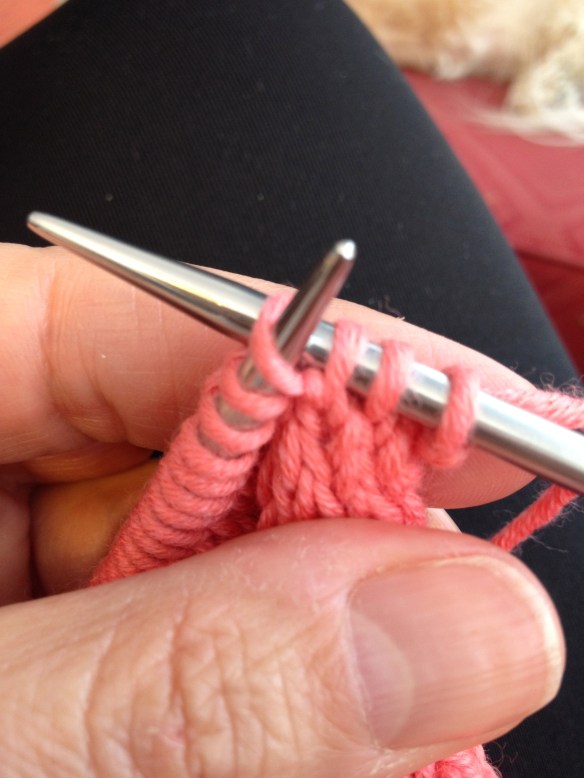
I’ve knitted two stitches and am knitting into the front and back of the third stitch. I’ve already knitted into the front and now I’m knitting into the back.
OK, so, I’ve wrapped the yarn around the working needle and slipped the stitch off the left-hand needle and this is what it looks like. There are my three “old” stitches and my “new” or “added’ or “increased” stitch. (Remember the first stitch is the the one to the right in the photo. The added stitch is the left-most stitch, the stitch just worked.)
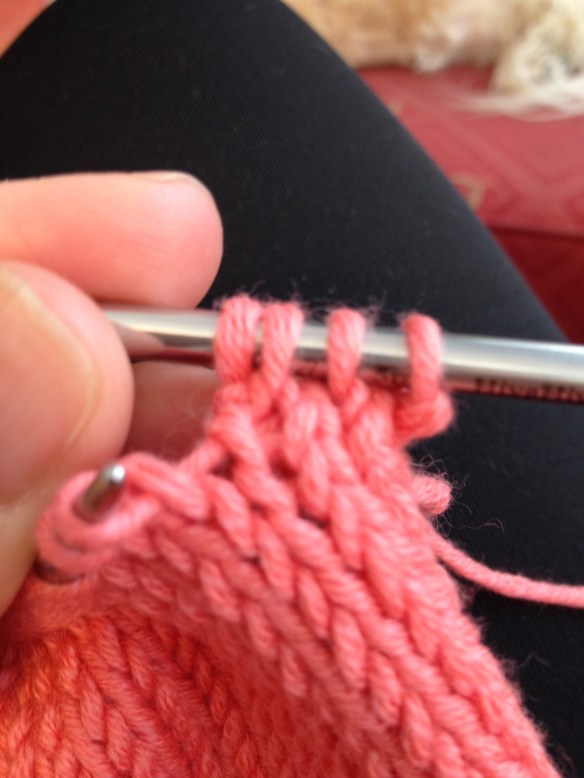
Three stitches is now FOUR! But can you see the “purl bump” on the fourth stitch (the left-most)?
So, we’ve accomplished our goal which was to increase one stitch. That stitch, however, isn’t invisible because of the little purl-like bump that is sitting in front of it. There’s nothing you can really do about it. And most times when you increase using the K1FB method, you’ll be increasing close to the side of a garment and those stitches will be swallowed up in a seam and will be virtually invisible after seaming.
BUT there is a way to make the stitches less visible and this is how you do it!
The first step is to knit into the front of the stitch but (again) don’t slip the stitch off the left-hand needle. (This is the exact same as the K1FB that I illustrated above.)
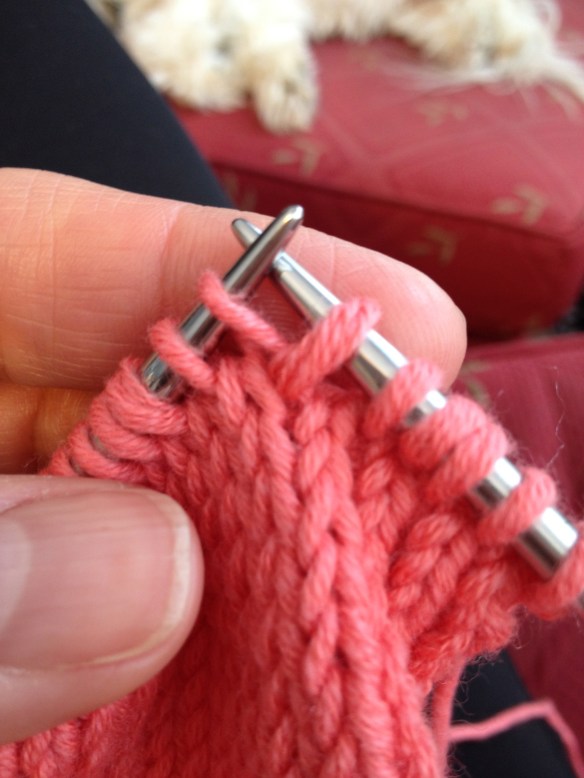
When you get to the stitch where you want to increase, knit into the front of the stitch.
The second half of the stitch needs to be reoriented so that the stitches don’t wrap around the front of the work. So, you’ll slip the next stitch knitwise by inserting the tip of the right needle from left to right (just like you were knitting the stitch) and slip the stitch from the left-hand to the right-hand needle.
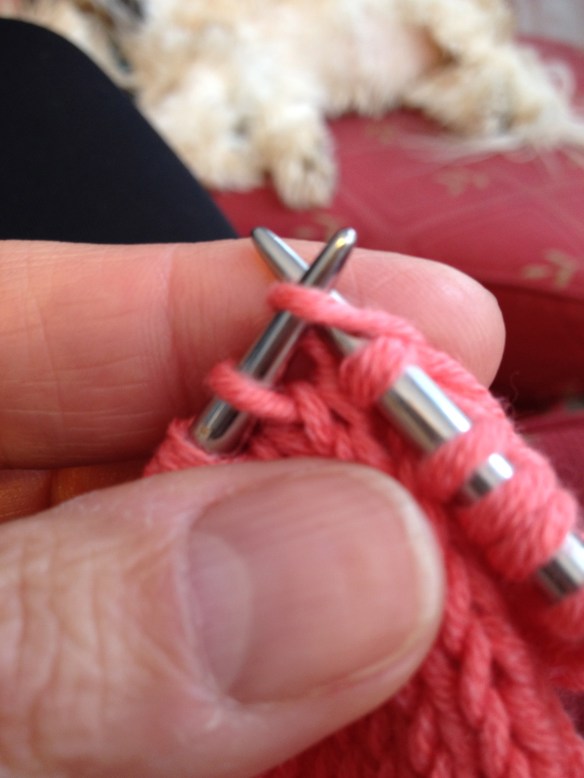
Next, insert your working (right-hand) needle into the front leg of the next stitch to be worked on the left-hand needle knitwise.
I know it sounds confusing, but I am at a disadvantage not being able to film myself in a video here! It forces me to find the right words to explain the process clearly and that’s good for both of us!
Next you’re going to slip the stitch back onto the left-hand needle to finish the process. Insert the tip of your left-hand needle purlwise into the stitch you just slipped to the right needle. Slip the stitch back to the left-hand needle.

Slip the stitch purlwise back to the left-hand needle … you’re almost there!
All you’ve done is slipped the second part of the stitch increase from the left to the right knitwise (as if to knit) and then back from the right to the left purlwise (as if to purl). This has reoriented the legs of the stitch so that when you (next!) knit it, the stitch isn’t wrapped with yarn (and it doesn’t look as much like a purl bump.)
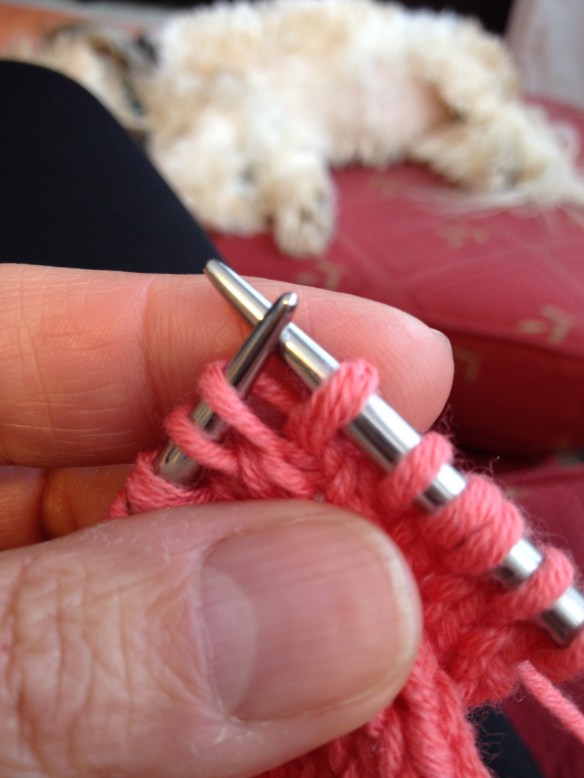
This is how your reoriented stitch looks … and now you are going to knit it.
Go ahead, knit the stitch and slip it off the left-hand needle. There! You have increased one stitch.
If you look at the next photo now, you’ll see that there is a “normal” K1FB increase and a K1FB increase where I’ve changed the orientation of the increased stitch.
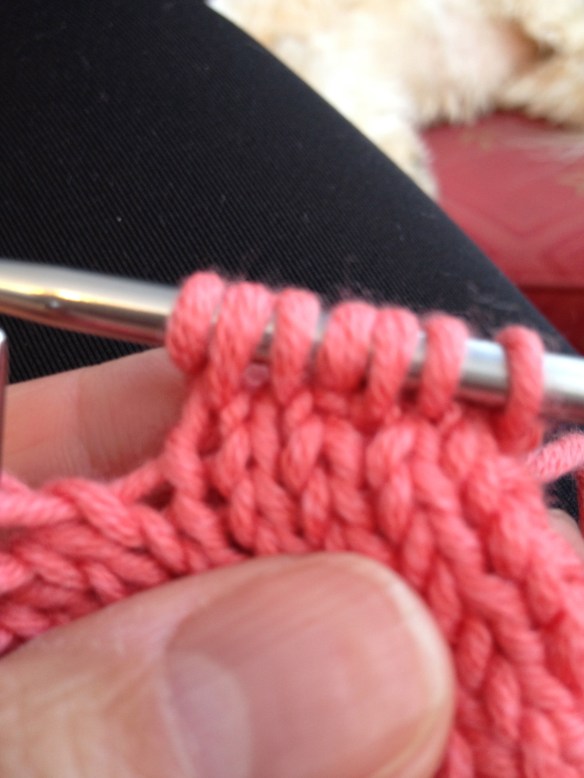
Reading from right to left: K2, K1FB (the old way where it looks as if the fourth stitch has a purl bump), K1, K1FB (the new way with changing the orientation of the increased stitch.)
See! No purl bump thingy! Now I’ll purl back across the stitches and you can see the fabric again …
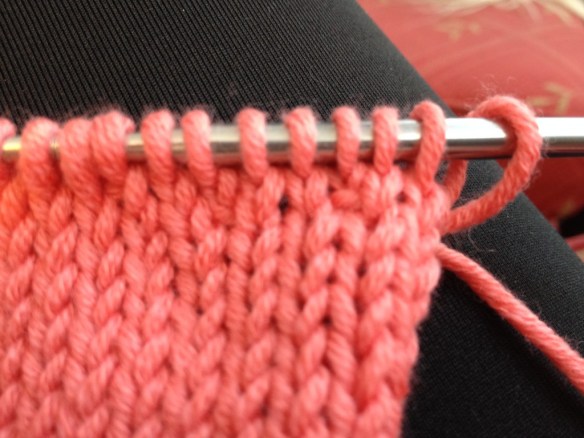
Again, reading from right to left you’ll see three knit stitches, one knit stitch with the “purl bump” below it and another two knit stitches and a new stitch from our reoriented K1FB.
There you have it! Two ways to increase in your knitting with K1FB (knit one front and back).
The first increase in stitch #3 (read from right to left) was the “old” knit one into the front and back of the third stitch which creates a fourth stitch with a “purl bump”. This is an excellent way to increase! Super quick and easy, just a bit visible in some circumstances.
The second increase in stitch #7 is done similarly but with a little twist of the second half of the increase where we reoriented or changed the orientation of the stitch before knitting it. This creates an added stitch without a wrap or “purl bump”. It’s pretty cool, isn’t it?
Learning to read your stitches is essential to your success as a knitter. I’m getting more skilled at it every time I take on a new project and teaching has helped me tremendously. This photograph, however, is such a clear one … and I get all excited.
When looking at this last photo, I can see the stitches added! Take a good look. The stitches in a each row are all lined up like a v on top of a v. Nice and neat! You can follow the stitches up in the center of the v. Where the increased stitches are added, it’s a little bit squeezed and the pretty symetry
VVVVV
VVVVV
VVVVV
When we increase a stitch, it squishes an extra stitch into the nice neat lines.
vvVvvVV
VVVVV
VVVVV
It’s a good attempt to illustrate with my limited illustration skills. I think. 🙂
Now that you’ve seen my excellent illustration, go back and have a look at the last photograph (I’ve added it below for you). Start at a stitch on the needle and follow the “v” down the rows. See how they line up? And can you see where the increased stitch just kind of pops up out of nowhere? It doesn’t have a nicely stacked column of “v”s to sit on top of … it’s just out there. The first K1FB increase (with the “purl bump” below it) stands out a lot more than it’s “cousin” the second K1FB “with a twist” but similarly, it just kind of gets nestled in between two stitches … each of the stitches has its column of “v”s but the increased stitch is sitting out there without a column. Can you see it now? Isn’t it exciting? You’re reading your knitting!
Read your knitting!!! Stitches are sitting in a column of “v”s; row sits squarely on the row below it … until you have an increased stitch!
There you have it! How to make a K1FB increase without having that wrapped stitch that looks like a purl bump. I am such a knitting geek!
What else do you want to learn about increases?
Gone knitting!
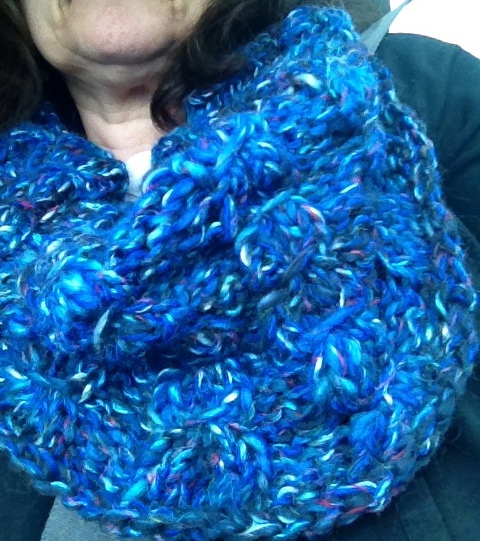
Mojo Jojo Cowl in Berroco Mojo
I just completed a quick-knit cowl with some lovely yarn Santa brought for me. The yarn, Berroco’s Mojo in a bee-utiful shade of blues (Color 8001/Dye lot 2078). With two stitches to an inch on size US15 needles, this super bulky yarn knits up really quickly … the cowl took maybe four hours of knitting (and I’m a slow knitter).
The pattern, Mojo Jojo, is a free Ravelry pattern. I wasn’t sure what I wanted to knit up with the two hanks that Santa brought me but when I searched Ravelry (and I am moving to Maine in a few months) I found the cowl pattern and decided that THIS was a good plan. The pattern uses what is called a “faux cable”. I’m not sure that I agree with that term as it looks more like a stretched stitch to me but if you really want to stand back a few feet and squint, I guess one might say it looks like a cable … or maybe not. Regardless, the cowl is very attractive and it was a quick and easy knit project that I completed in a few hours. I will get a lot of wear out of it in Maine next winter.
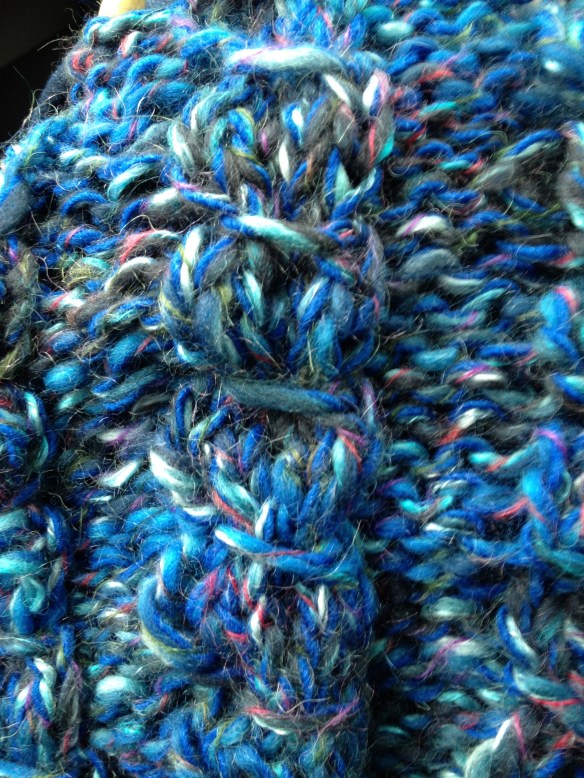
Mojo Jojo Cowl Close-up … faux cable?
The faux cable is created by slipping one stitch, knitting four stitches and then passing the slipped stitch over the four knitted stitches. When knitting this cowl, I followed my slipping stitches rule #2. I slipped the first stitch knitwise because I was going to use it again in the next row.
So, let’s talk about slipping stitches in knitting.
A lot of knitters struggle with how to slip stitches and what is the “right” way to slip a stitch. So, here are the rules of slipping stitches according to me (the Queen Bee!)
Rule 1. If the pattern doesn’t state how to slip the stitch, the default is to slip the stitch from the holding needle (usually the left-hand) to the working needle (usually the right-hand) purlwise. There is no twist to the stitch, it’s passed from one needle to the other. Insert your working needle (right) purlwise (from the right to the left) into the first stitch.
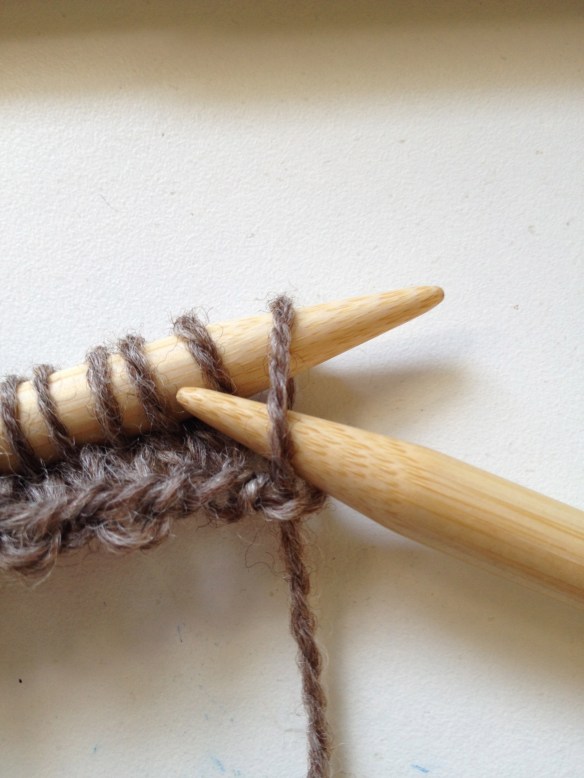
Slip purlwise
Rule 2. If you are going to use the slipped stitch again in the same row, then slip the stitch knitwise as in a SSK (slip slip knit) or PSSO (pass the slipped stitch over). This way the stitch is twisted as it is slipped from one needle to the other.
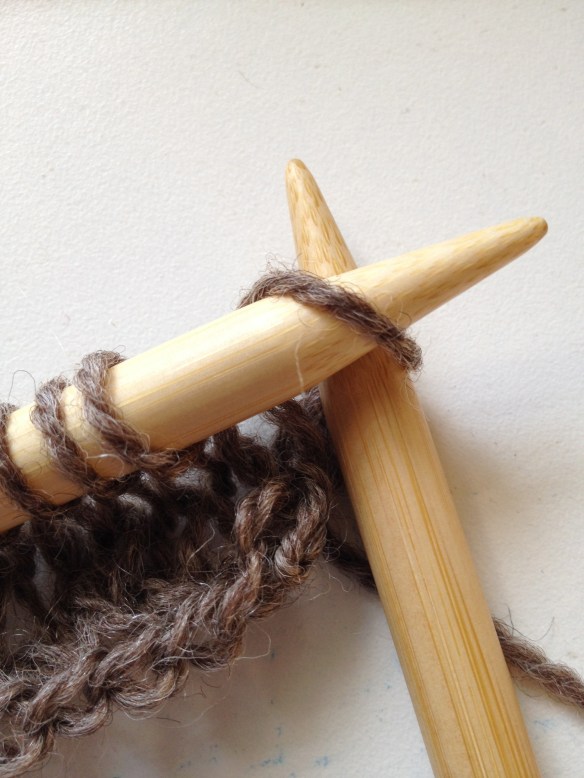
Slip Knitwise
Rule 3. If the directions tell you to slip the stitch(es) knitwise, then follow the instructions.
There you go! So simple that I even complicated the process with adding rule number three which, technically, is an obvious rule and should not even be mentioned. However, I have learned that I should not ever assume so the obvious becomes rule number three.
Gone knitting!
 Queen Bee Knits