2017! Happy New Year!

img_0323

I feel fortunate that 2016 was a wonderful year for me and for my family. One daughter bought a new home, another daughter became engaged, I married the love of my life and we had all of our children in our house at the same time (for the first time). Our children are gainfully employed, healthy and happy. We are both working at jobs we love and are paying the bills, we have food on our table, a warm home and we are healthy. What more can you ask for?

I am eager to see what 2017 brings and what opportunities in the fiber world I will become involved with. I am excited to continue teaching knitting and creating in my every-improving atelier! This year’s goal is to add some serious shelving to my studio for fabric and yarn storage. I am already realizing that my “cheap fix” is not going to work long-term … fabric and yarn multiply when packed into small spaces and despite working hard to knit from my stash, it’s only minimally smaller.

img_7778We had a quiet New Year’s Eve at our house. A summer camp (childhood) friend and his son joined us for a lobster feast and a glass or two of sparkling wine prior to midnight. The guys all stayed awake after the power went out but I claimed the black-out as an opportunity to go to bed “early”. This is our photograph, grainy though it may be, from around 10:30pm. I love selfies with this guy and can’t wait to see what 2017 brings to add to our life together.

My goals for the year are to attend and help with, perhaps, the fiber week at my old summer camp. I’m looking forward to Maryland Sheep & Wool, too. I want to do more in my community – attend events, help my neighbors, life my best life and speak from my heart (not usually a problem). I want to floss more often and remember to listen to myself and speak my truth. Having lost my voice a long time ago, it feels wonderful when I speak out and speak up and feel heard. I’ll keep working on that piece.

img_7781

Wishing you blessings in 2017. I’m hoping that it’s the best year yet for all of us!

Gone knitting.

Laughing All the Way

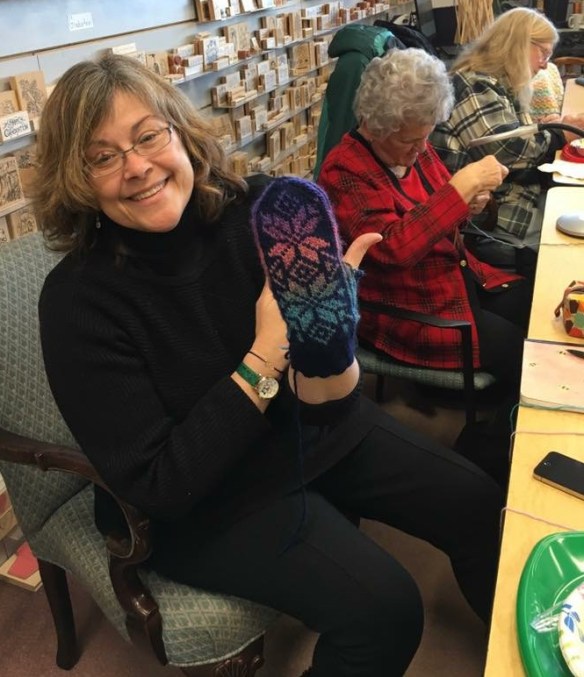
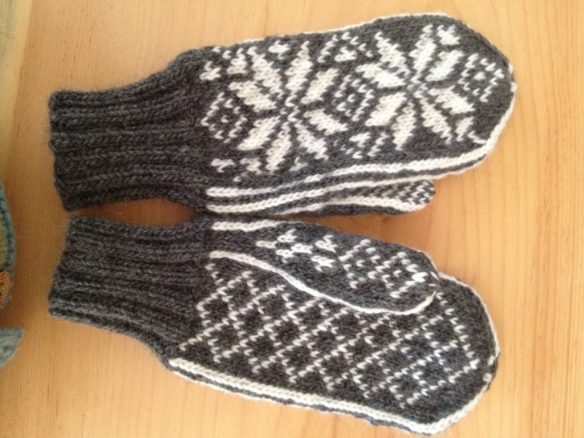
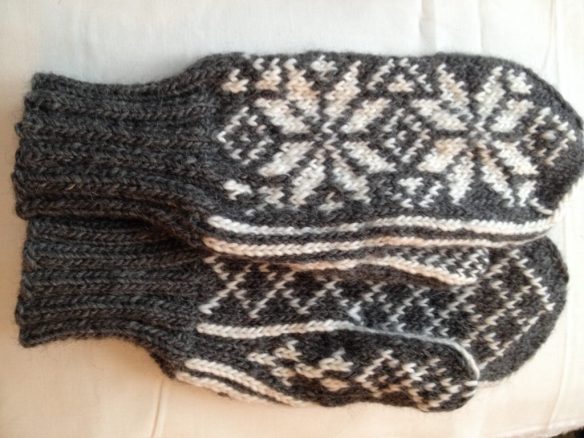
I have had a wonderful experience teaching three wonderful students a stranded knitting class. We made “my” Four Needle Snowflake Mittens. These are my favorite mittens to date. I love knitting them. The pattern came from my colleague and teacher, Bette. It’s an old and often-copied pattern but it’s a great one!

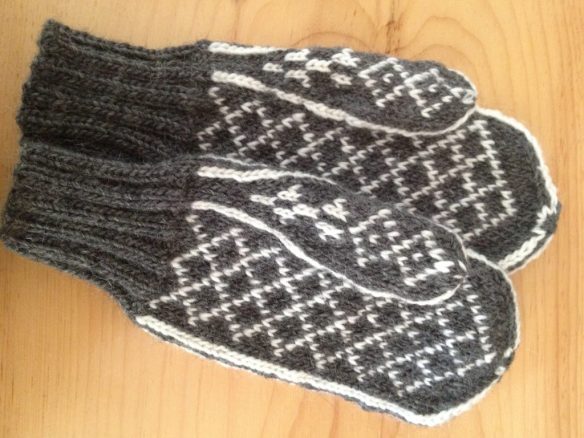
At our last class, I was explaining the difference between mittens that are the same (can be worn on either hand) and mittens that are knitted specifically for either the left or right hand. I pulled out my finished pair of mittens to show the ladies what I was talking about  and …img_7658

Do you see the problem?

How about now?

img_7657

Ha! Ha! Ha! It’s so good that I have learned how to laugh at myself! I realized that I had knitted TWO LEFT MITTENS!!! What a teachable moment! Even the teacher can make mistakes!

I’ve shared this story with everyone at work, my other classes and just about everyone that I have spoken to and every single time I laugh. Out loud! I still find it hilarious!

Since these were to be a Christmas gift for a very special person who happens to have a left and a right hand, I have had to finish a third mitten … this one is for the other hand! LOL. My students continue to teach me as much as I teach them!

Now, I’ve got them fixed – and the fourth mitten will be finished after I complete another pair. Wait until you see them!

img_7681

Today’s lesson learned – never take yourself too seriously!

Gone knitting.

Teaching and Technology

Choices!

Choices!

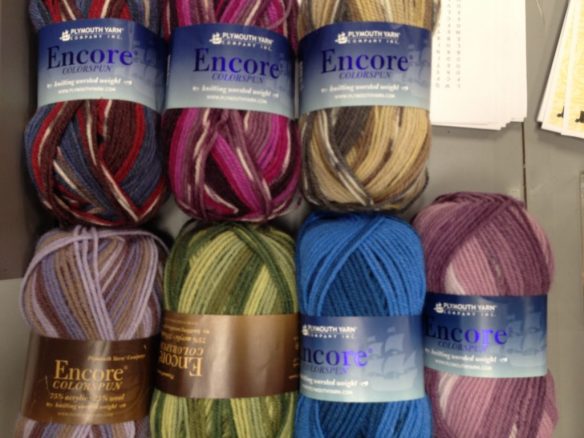
Last week I sent some yarn to a customer who lives far away. She wanted to make socks out of Encore Worsted yarn. I sent her a picture of a few choices and we got it mailed to her. On Wednesday I got a phone call and she was stuck. She had gotten her leg and heel flap done, had turned the heel and picked up the gusset stitches. But despite having done all the “hard” work she was stuck on the directions to knit the next part – mostly on having the right number of stitches on each needle so she could decrease in the right spot!

Now, any of you who have ever tried to explain something over the phone understand how difficult it is, right? I think every teacher, at one time or another, assigns students to give directions in writing for someone who has never done something. Dialing a phone, making tuna salad? It’s not easy to fully describe any task where you are unable to see the person to whom you are giving directions.

So, I’m on the phone with a customer who is stuck on her sock. First I have to figure out where she is exactly. Next, I have to explain to her what to do next. Well, on Wednesday I didn’t do a good job. We couldn’t find a place where we could communicate with each other well enough to solve the problem. I was feeling like a failure and she was frustrated.

And then she suggested that she might send me a picture! It was a genius idea!

img_7714

This was the picture I got via email

This is the picture that I got. You can see where the working yarn is (at the bottom left-hand corner of the needles) and, if you’ve knit many (MANY) pairs of socks, you know exactly what you would do next. Right? But can you describe to someone over the phone what to do? Well, after spending fifteen minutes on the phone without making any real progress, we finally had a new starting place and new hope!

Once I saw exactly where she was, I could then explain to her what she needed to do next.

She knitted down the left-hand needle and then knitted half of the heel (top) stitches. This becomes needle number three. We are now at the new beginning of the round. Now she can begin her first round with gusset decreases – Needle one will be the second half of the heel stitches and the right-hand needle stitches, the bottom needle is the top of the foot and will be needle two. We already know where needle three is!

Working together with our photograph and the use of our wonderful new technology …

Success!

img_7715

Now she’s ready to complete her foot.

I am so grateful for the challenges that I am given as a teacher.  I love the brain work that it takes to figure out how to solve a challenge for the student and for me. And I have made some wonderful connections and created wonderful friendships, too. I’ve said it before and I’ll say it again, I love teaching knitting!

knitonwithconfidence2

The Right Way(s) to Yarn Over

My knitting classes have been asking about the correct way to make a yarn over. I’ve shown them the right way to do one between knit stitches but my answer falls somewhat short because there are several ways to yarn over and it all depends on which stitches the yarn over falls between.

I went searching for a good video tutorial and found this one from Purl Soho (see a picture of me at Purl Soho here!) that explains all of the ways to do a yarn over … between two knit stitches, between a knit and a purl stitch, etc.

This is the best video tutorial I’ve seen! But Purl Soho is one of the best yarn shops I’ve seen, too! (If you get a chance to visit, please do!)

It’s excellent, right?

Gone knitting.

Moving, Test Knitting and Christmas

IMG_5849I can’t figure out what drove me to say “yes” to a test knitting project this close to Christmas when I knew I had several knitting projects that had to be completed before Christmas! What was I thinking? Oh, yes. Maybe I was thinking that the last sweater I test knitted for Lori was a big hit and I loved it and this one would be great, too?

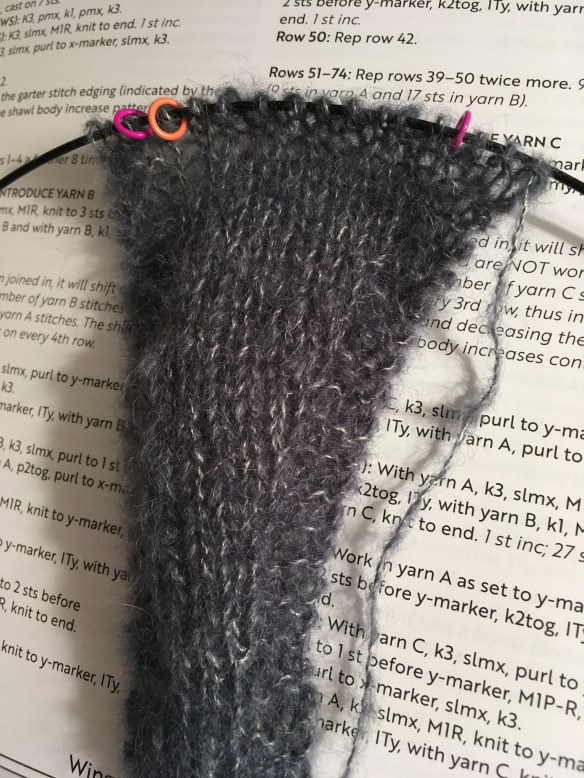
So, I have set aside all the other projects in favor of “Open Star” by VersaciKnits. Lori designs classic and timeless sweaters for adults and children. I love her designs. Open Star is a cardigan with a classic shape and a unique stitch pattern that leaves a “lacey” look without being a lace pattern. Knit in a worsted- or aran-weight yarn, it’s a relative quick-knit. (I’d have had it done long ago if I hadn’t had to move into a new home two weeks before it was due to be completed.) Needless to say, my test knit is late this time. But I have enjoyed it … most of the time.

To complete this sweater, one has to be able to count to four and three. Sometimes this is a challenge for me. This is where I have made mistakes and had to frog back several rows (time after time.) To be fair, it can be a bit confusing when you get to the shaping of the shoulder and neck. But not confusing enough for me to have made so many silly mistakes. I think my head and heart were unpacking boxes when my hands were knitting.

I love the yarn that I chose and that is Quince and Co’s Lark in the Lupine colorway. The yarn is smooth and squishy and feels wonderful in my hands. It’s got a wonderfully soft hand and isn’t splitty. I love the color, too.

I am looking forward to finishing the sleeves so that I can assemble and wear this lovely cardigan … especially since this “winter” in Maine has been so warm. This would be the perfect “jacket” to wear out Christmas shopping!

Gone knitting!

Remembering Why I Love Cables

Sirdar Snuggly Double Knitting Patten #1516

Sirdar Snuggly Double Knitting Patten #1516

Perhaps it’s partly my Irish heritage (the part of my heritage that I feel most connected to) or maybe it has no relation at all but I love, love, love cables!

I have two projects on the needles right now that I am enjoying. One is a little cable-knit poncho for my niece in California (I’ll be knitting a matching one for her little sister, too) the other is an infinity scarf/cowl for my daughter. The poncho has a great cable pattern that I am loving. It’s a Sirdar pattern (#1516), using Sirdar Snuggly Double Knitting (DK) yarn and a size US3 and US6 knitting needle. I’m using my Knitter’s Pride interchangeable needles which have great points for this yarn. You can buy them here or here. I love mine!!!

I’m going to spend this post talking about why cables are so simple and look so difficult and show a few pictures so that, if you’re a newbie to knitting and are a little bit afraid of cables, you’ll jump right in … because they’re really so much easier than they appear to be! Be brave! Go for it! Give it a try! (Rah! Rah!)

What my cable pattern looks like~ complicated, right? Wrong!

What my cable pattern looks like~ complicated, right?  …Wrong!

It really does look complicated, doesn’t it? I promise you that it’s really not complicated at all. All you need to do is lift a couple of stitches off the left needle and then knit a couple of stitches and then knit the lifted/slipped stitches. Follow along with me, I’m going to show you what I mean in a step-by-step tutorial.

IMG_5445

Left needle is holding stitches to be worked next … and we’re ready to make a cable!

I’ve knitted (or in this case, purled) over to where the stitches are that will be my cable (they are the knitted stitches, 8 of them between purl bumps).

If you examine the photo carefully, it’s just like it was sitting in your lap. The right hand needle is the one holding stitches that have already been worked. The left hand needle is the stitches that will be worked next. You can see the stitches several rows below where I am now working that have been cabled already. That’s a helpful hint. In  this pattern, the cables are neatly stacked up on top of each other.

It is time to slip two stitches off the left-hand needle and hold them to the front of my work with my cable needle. I am using a cheap aluminum cable needle that I bought at JoAnn’s ages ago. I lose a lot of cable needles so cheap is good for me.

Slip two stitches from the left-hand needle to the cable needle without twisting or as if to purl.

To the left is a picture of the two stitches slipped onto the cable needle and being “held” in front of my work. If not careful, the cable needle will slip out of the stitches whether you hold it or not. But it’s not a crisis. The only time any damage comes to “dropped” stitches is when you pull. If you don’t pull your stitches, you can slip them right back onto the cable needle (or any other needle for that matter).

Now, I’m goinIMG_5450g to knit the next two stitches on the left-hand needle. And hopefully I will not drop the cable needle. And then I will knit the two stitches from the cable needle.

When that is done, I’m half way there.

I still have one more part of the bigger cable to do and that means slipping two stitches to the back of my work in the same manner that I slipped the stitches to the front. I will knit two stitches from the left hand needle and then knit the two stitches that are held on the cable needle in back of my work. Wait! I’m going to show you …

Just a note about cables – Cables are always either left-leaning or right-leaning. When you hold your cable stitches to the front the cable will be left-leaning (I remember that by thinking about left having the “f” in it which stands for front). And in the same vein, the right leaning cables will always be worked from stitches that are held to the back. (I haven’t got a mnemonic for that, but you have the one for the left-leaning so I hope you don’t need one for the right-leaning …. right?)

Knitted two from the working needle and two from the cable needle held in front. Now it's time to slip two more stitches and hold them to the back.

Knitted two from the working needle and two from the cable needle held in front. Now it’s time to slip two more stitches and hold them to the back.

Here is my work after having knitted the first four stitches (two from the needle and two from the cable needle held in front.)

Now it’s time to finish the cable.

We are going to slip two stitches from the left-hand needle to the cable needle and hold it to the back of our work. (This will be a right-leaning cable … can you see how the first part of this cable that we just finished is leaning to the left?)


IMG_5448

We have slipped two stitches onto the cable needle and they are being held to the back of our work …

Once the two stitches are on the cable needle and at the back of the work as in the photograph to the right, you can knit the next two stitches from left-hand needle … and then knit the two stitches from the cable needle.

Ta! Da!

You’ve just worked a cable! Woo! Hoo!


8-stitch cable with one side leaning right and one side leaning left

8-stitch cable with one side leaning right and one side leaning left

My two fingers are marking the eight stitches that we’ve just manipulated to make this “double” cable. The first side we knitted (on the right in this photo) leans to the left and the second side (on the left in this photo) leans to the right. Can you see this??? Under my fingers are two purl bumps … there are purl stitches on both sides of the cable. Purl stitches make the cable pop!

Simpler still, a 4-stitch cable

Simpler still, a 4-stitch cable that leans to the left and to the right


The other cable in this pattern is a simpler four-stitch cable.

The process is the same as far as the knitting goes. This cable leans to the left and then it leans to the right. Yup, you guessed it! When making up this cable, one time you’ll bring your cable needle with its two stitches to the front (left-leaning) and then the next time, you’ll bring it to the back (right-leaning).

Every cable pattern has a number of rows that it takes to make the cable happen consistently (and look just right!) This pattern just happens to have an eight-row repeat and the “difficult” rows are the first and fifth. These are the rows where I use the cable needle and cross or twist my stitches. The other six rows are super simple combinations of knit and purl stitches.

So now you’re ready to cast on some stitches and give cables a try, right? I hope this has helped to make you feel more comfortable with the idea of cables … cast on 22 stitches with any plain-colored light yarn and an appropriately-sized set of needles and give this a try! Here’s your “pattern”…

Cast on 22 stitches

Set up Row (wrong side of knitting): K2, P4, K3, P8, K3, P4, K2

Row 1 (right side of knitting): P2, C4B, P3, C4B, C4F, P3, C4B, P2

(remember: C4B means hold 2 slipped stitches to the back of work, knit 2 from working needle, knit 2 from cable needle and C4F means hold 2 slipped stitches to the front of work, knit 2 from working needle and then knit 2 from cable needle)

Row 2 (and all other even rows): K2, P4, K3, P8, K3, P4, K2

Row 3: P2, K4, P3, K8, P3, K4, K2

Row 5: K2, C4F, P3, C4F, C4B, P3, C4F, K2

Row 7: repeat row 3

Row 8: repeat row 2 (obviously)! This is the end of the 8-row repeat.

Give it a try and let me know how you do!

For now, I’ve gone knitting!


Three Cheers (for the Red, White and Blue)

Yesterday I spent a wonderful day learning something new.

The Class Sample … this is what my quilt will look like

The Class Sample … this is what my quilt will look like

I took a Flag Quilt class at the Cotton Cupboard in Bangor, Maine with a friend and we had a great time. It was my first ever quilt-making class and it was a positive experience for this  once-a-failure sewer!

I’ve made a few other quilts in my life. I made several Amish Tied Quilts back when my children were little. One for each of them and a few others interspersed. They are funny to look at today … my color choices “date” the quilts with the exception of the eldest daughter’s which is red, white and blue. My quilt already shows that I was into the black and yellow “bee colors”. I have all of them here in Maine and one day they’ll go to the kids homes … when they all have room for a quilt.

My Log Cabin Quilt …  finished and on our bed

My Log Cabin Quilt … finished and on our bed

The last two summers I worked on a Log Cabin quilt which I finished and had quilted at Quilt Divas in Rockland. I love it and it’s on our bed.

The quilt that I’m working on for this class is a throw quilt and it’s got several things going on. It’s straight piecing, some appliqué and some curved sewing. I’ve never sewn a curved seam in my life! I felt relatively adept at the cutting and straight sewing although one of my classmates gave me a couple of new tips that I really appreciated. The appliqué I had done once and that was alright. I have a lot more stars to appliqué so I’ll be a professional when they’re all done! The curved sewing will take me awhile … and is my biggest challenge.

Curved seams … I did pretty well. It just takes time

Curved seams … I did pretty well. It just takes time

When I was all done, I was sore and feeling successful … I had only screwed up one star square (and have to cut a few other pieces to be able to finish my quilt) because I hadn’t been warned about making sure the squares were not all facing the same way. Fortunately I have extra fabric!

I will keep plugging along at it and I will show the pictures of the final project …. whenever I get it done (and quilted.) Since it’s a throw, I’ll plan to quilt it myself.

Gone knitting!

Private Lessons

Sock Anatomy … I love teaching knitting!

Sock Anatomy … I love teaching knitting!


Yesterday I taught one of my knitting friends how to knit socks (on DPNs.) She was apprehensive at first and cast on with a death grip on the yarn. Row 1 was a bit easier but not natural yet.

“Keep at it, the muscle memory will come. I promise”, I coached.

And it did! By row two or three she got it! Yay!

I can’t wait to meet next week and teach her to turn a heel!

Gone knitting!

K1FB Increasing Without Tears …or those pesky little “purl bumps”

This morning I happened across a video for adding a stitch in your knitting without that funny little purl bumpy thing that happens when you knit one into the front and back of the stitch (K1FB). I have gone back to try to find the video but I can’t find it. So, in my own inimitable fashion, I’m going to attempt to show you, dear patient readers, with words and photographs what the video said.

There are many increases to use when you’re knitting. The “quickest and easiest” is K1FB or knit one into the front and back of a stitch. You can use this increase when you see “M1” in a pattern but I’d recommend that you use this as a generic increase rather than a M1 (make one).

When you get to the place where you need to increase, you are going to knit into the front of the stitch (which I’ve already done in the photo below) and then, without dropping the stitch off the left-hand needle, you’re going to knit into the back of the stitch. The photo below shows the stitch that I am adding by knitting into the back … I’m ready to wrap and then slip the stitch off the left-hand needle.

I've knitted two stitches and am knitting into the front and back of the third stitch. I've already knitted into the front and now I'm knitting into the back.

I’ve knitted two stitches and am knitting into the front and back of the third stitch. I’ve already knitted into the front and now I’m knitting into the back.

OK, so, I’ve wrapped the yarn around the working needle and slipped the stitch off the left-hand needle and this is what it looks like. There are my three “old” stitches and my “new” or “added’ or “increased” stitch. (Remember the first stitch is the the one to the right in the photo. The added stitch is the left-most stitch, the stitch just worked.)

Three stitches is now FOUR! But can you see the "purl bump" on the fourth stitch (the left-most)?

Three stitches is now FOUR! But can you see the “purl bump” on the fourth stitch (the left-most)?

So, we’ve accomplished our goal which was to increase one stitch. That stitch, however, isn’t invisible because of the little purl-like bump that is sitting in front of it. There’s nothing you can really do about it. And most times when you increase using the K1FB method, you’ll be increasing close to the side of a garment and those stitches will be swallowed up in a seam and will be virtually invisible after seaming.

BUT there is a way to make the stitches less visible and this is how you do it!

The first step is to knit into the front of the stitch but (again) don’t slip the stitch off the left-hand needle. (This is the exact same as the K1FB that I illustrated above.)

IMG_4271

When you get to the stitch where you want to increase, knit into the front of the stitch.

The second half of the stitch needs to be reoriented so that the stitches don’t wrap around the front of the work. So, you’ll slip the next stitch knitwise by inserting the tip of the right needle from left to right (just like you were knitting the stitch) and slip the stitch from the left-hand to the right-hand needle.

IMG_4273

Next, insert your working (right-hand) needle into the front leg of the next stitch to be worked on the left-hand needle knitwise.

I know it sounds confusing, but I am at a disadvantage not being able to film myself in a video here! It forces me to find the right words to explain the process clearly and that’s good for both of us!

Next you’re going to slip the stitch back onto the left-hand needle to finish the process. Insert the tip of your left-hand needle purlwise into the stitch you just slipped to the right needle. Slip the stitch back to the left-hand needle.

IMG_4274

Slip the stitch purlwise back to the left-hand needle … you’re almost there!

All you’ve done is slipped the second part of the stitch increase from the left to the right knitwise (as if to knit) and then back from the right to the left purlwise (as if to purl). This has reoriented the legs of the stitch so that when you (next!) knit it, the stitch isn’t wrapped with yarn (and it doesn’t look as much like a purl bump.)

IMG_4275

This is how your reoriented stitch looks … and now you are going to knit it.

Go ahead, knit the stitch and slip it off the left-hand needle. There! You have increased one stitch.

If you look at the next photo now, you’ll see that there is a “normal” K1FB increase and a K1FB increase where I’ve changed the orientation of the increased stitch.

IMG_4276

Reading from right to left: K2, K1FB (the old way where it looks as if the fourth stitch has a purl bump), K1, K1FB (the new way with changing the orientation of the increased stitch.)

See! No purl bump thingy! Now I’ll purl back across the stitches and you can see the fabric again …

IMG_4279

Again, reading from right to left you’ll see three knit stitches, one knit stitch with the “purl bump” below it and another two knit stitches and a new stitch from our reoriented K1FB.

There you have it! Two ways to increase in your knitting with K1FB (knit one front and back).

The first increase in stitch #3 (read from right to left) was the “old” knit one into the front and back of the third stitch which creates a fourth stitch with a “purl bump”. This is an excellent way to increase! Super quick and easy, just a bit visible in some circumstances.

The second increase in stitch #7 is done similarly but with a little twist of the second half of the increase where we reoriented or changed the orientation of the stitch before knitting it. This creates an added stitch without a wrap or “purl bump”. It’s pretty cool, isn’t it?

Learning to read your stitches is essential to your success as a knitter. I’m getting more skilled at it every time I take on a new project and teaching has helped me tremendously. This photograph, however, is such a clear one … and I get all excited.

When looking at this last photo, I can see the stitches added! Take a good look. The stitches in a each row are all lined up like a v on top of a v. Nice and neat! You can follow the stitches up in the center of the v. Where the increased stitches are added, it’s a little bit squeezed and the pretty symetry

VVVVV

VVVVV

VVVVV

When we increase a stitch, it squishes an extra stitch into the nice neat lines.

vvVvvVV

VVVVV

VVVVV

It’s a good attempt to illustrate with my limited illustration skills. I think. 🙂

Now that you’ve seen my excellent illustration, go back and have a look at the last photograph (I’ve added it below for you). Start at a stitch on the needle and follow the “v” down the rows. See how they line up? And can you see where the increased stitch just kind of pops up out of nowhere? It doesn’t have a nicely stacked column of “v”s to sit on top of … it’s just out there. The first K1FB increase (with the “purl bump” below it) stands out a lot more than it’s “cousin” the second K1FB “with a twist” but similarly, it just kind of gets nestled in between two stitches … each of the stitches has its column of “v”s but the increased stitch is sitting out there without a column. Can you see it now? Isn’t it exciting? You’re reading your knitting!

IMG_4279

Read your knitting!!! Stitches are sitting in a column of “v”s; row sits squarely on the row below it … until you have an increased stitch!

There you have it! How to make a K1FB increase without having that wrapped stitch that looks like a purl bump. I am such a knitting geek!

What else do you want to learn about increases?

Gone knitting!


I’m a Crochet Queen Bee!

That's What I'm Talking About!!!

That’s What I’m Talking About!!!

Those of you who are loyal readers (such as it is since I haven’t been posting very often … this thing called work really obliterates my time to knit and blog about it) know that I’ve been saying that I have to learn to crochet. Well, I think I have accomplished a few steps in that direction.

I have a dear knitting friend, Terri, who is an accomplished crocheter, a good knitter and she is the Queen of Nuno Felting. One evening at our Wild Rows gathering, I asked her to show me a Granny Square and she did. I practiced for a couple of days until it started to feel more natural. Now I have a collection of Granny Squares …. I had thought I would make an afghan but I think I will make a cover for my ottoman that lives in my atelier. Time will tell but the pile keeps growing.

Granny Squares

Granny Squares

Then, my knitting group decided to make a baby blanket for one of our members. Terri reminded me that since it was to be a 12 x 12 inch square, it was a good way to practice more. This time we were asked to keep our squares to blues and/or browns.

12 x 12 inch Granny Squ

12 x 12 inch Granny Square

And then I found this bag pattern somewhere in the blog-oshpere or on Facebook or Ravelry. The pattern is here. It’s not in American crochet terms, which, I have learned are different from English/European (?) crochet terms so beware. I marched right out to my local Joann Fabrics and buy some cheap-o yarn to give it a go. I’d never followed a crochet pattern before and I didn’t know what the stitches were called. I found a tutorial on YouTube and off I went. My first attempt is in the “use it another day” bin because it didn’t look right. The second attempt is pretty darned good … in my humble opinion!

IMG_3979

I can even make a flower!

IMG_3982

The bag … lying down.


I was very pleased with my little flowers! They were to hide the rather ugly join that I had to make to get the handles attached to the bag. I think next time I would make the handles part of the body of the bag and leave it at that. BUT I love the little flowers and am glad to know how to make them … and add a couple of leaves on a couple of the handles and this is what they look like! I think it will become a gift this Christmas … stay tuned!IMG_3983Another project in the finished pile and now I can use the yarn to make a sampler blanket (baby sized) and learn a few more crochet stitches. Yay!

Gone knitting!