Teaching and Technology

Choices!

Choices!

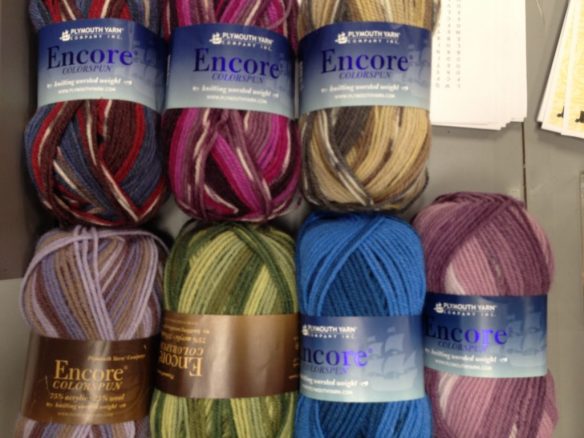
Last week I sent some yarn to a customer who lives far away. She wanted to make socks out of Encore Worsted yarn. I sent her a picture of a few choices and we got it mailed to her. On Wednesday I got a phone call and she was stuck. She had gotten her leg and heel flap done, had turned the heel and picked up the gusset stitches. But despite having done all the “hard” work she was stuck on the directions to knit the next part – mostly on having the right number of stitches on each needle so she could decrease in the right spot!

Now, any of you who have ever tried to explain something over the phone understand how difficult it is, right? I think every teacher, at one time or another, assigns students to give directions in writing for someone who has never done something. Dialing a phone, making tuna salad? It’s not easy to fully describe any task where you are unable to see the person to whom you are giving directions.

So, I’m on the phone with a customer who is stuck on her sock. First I have to figure out where she is exactly. Next, I have to explain to her what to do next. Well, on Wednesday I didn’t do a good job. We couldn’t find a place where we could communicate with each other well enough to solve the problem. I was feeling like a failure and she was frustrated.

And then she suggested that she might send me a picture! It was a genius idea!

img_7714

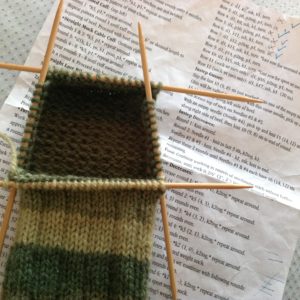
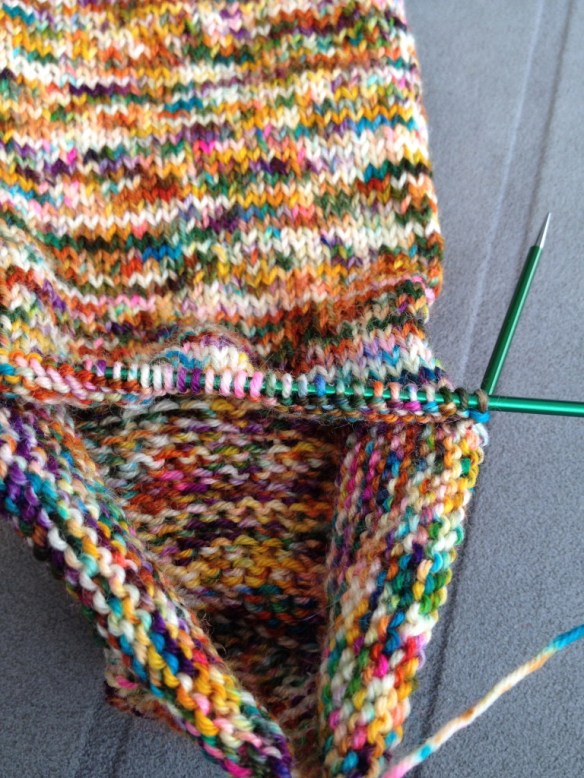
This was the picture I got via email

This is the picture that I got. You can see where the working yarn is (at the bottom left-hand corner of the needles) and, if you’ve knit many (MANY) pairs of socks, you know exactly what you would do next. Right? But can you describe to someone over the phone what to do? Well, after spending fifteen minutes on the phone without making any real progress, we finally had a new starting place and new hope!

Once I saw exactly where she was, I could then explain to her what she needed to do next.

She knitted down the left-hand needle and then knitted half of the heel (top) stitches. This becomes needle number three. We are now at the new beginning of the round. Now she can begin her first round with gusset decreases – Needle one will be the second half of the heel stitches and the right-hand needle stitches, the bottom needle is the top of the foot and will be needle two. We already know where needle three is!

Working together with our photograph and the use of our wonderful new technology …

Success!

img_7715

Now she’s ready to complete her foot.

I am so grateful for the challenges that I am given as a teacher.  I love the brain work that it takes to figure out how to solve a challenge for the student and for me. And I have made some wonderful connections and created wonderful friendships, too. I’ve said it before and I’ll say it again, I love teaching knitting!

knitonwithconfidence2

The Right Way(s) to Yarn Over

My knitting classes have been asking about the correct way to make a yarn over. I’ve shown them the right way to do one between knit stitches but my answer falls somewhat short because there are several ways to yarn over and it all depends on which stitches the yarn over falls between.

I went searching for a good video tutorial and found this one from Purl Soho (see a picture of me at Purl Soho here!) that explains all of the ways to do a yarn over … between two knit stitches, between a knit and a purl stitch, etc.

This is the best video tutorial I’ve seen! But Purl Soho is one of the best yarn shops I’ve seen, too! (If you get a chance to visit, please do!)

It’s excellent, right?

Gone knitting.

A Wonderful Gift

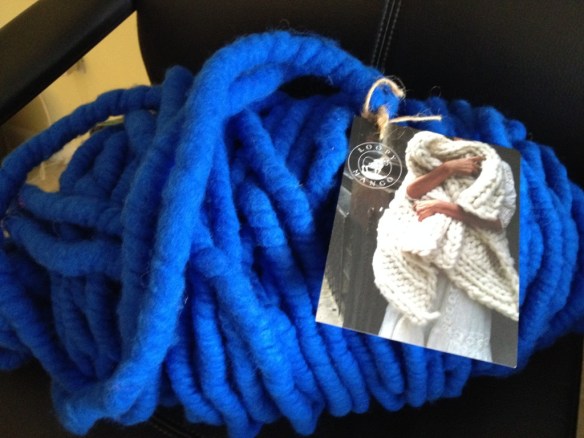
I taught my next-to-last last knitting class on Saturday and at the end of the class, Anne, the owner of The Black Sheep in Orlando wanted to give me a gift. A beautiful “little” skein of big yarn.

What a Wonderful Gift!

What a Wonderful Gift!

I’m so grateful for the opportunity to teach knitting in this wonderful shop and for the friendship that we’ve enjoyed. Who knew I’d meet such a great friend in a puppy training class?

I can’t wait until you come to Maine!

Gone knitting.

Private Lessons

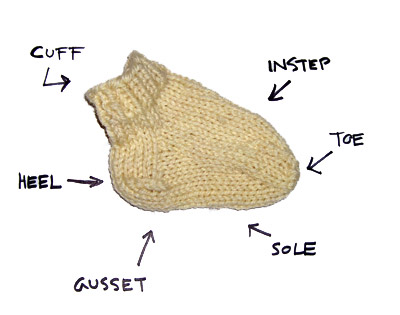
Sock Anatomy … I love teaching knitting!

Sock Anatomy … I love teaching knitting!


Yesterday I taught one of my knitting friends how to knit socks (on DPNs.) She was apprehensive at first and cast on with a death grip on the yarn. Row 1 was a bit easier but not natural yet.

“Keep at it, the muscle memory will come. I promise”, I coached.

And it did! By row two or three she got it! Yay!

I can’t wait to meet next week and teach her to turn a heel!

Gone knitting!

Needles, Needles, Needles

I’m working a lot knitting socks. Trying some new patterns and trying different needles, too.

Knitter's Pride Dreamz DPN

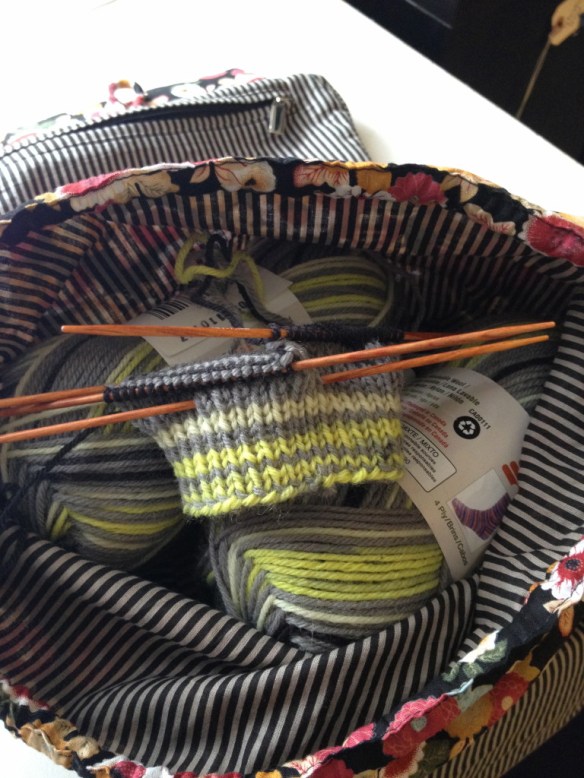
Knitter’s Pride Dreamz DPN

I have a set of new Knitter’s Pride “dreamz” 6-inch double pointed needles in US1 (2.25mm) needles and they’re going to help me knit up some wonderful socks using  Susan B. Anderson’s “How I Make My Socks” pattern and Patons Kroy Socks in Spring Leaf Stripes colorway (that I’ve had in my stash for a few months.) I am really liking these needles. They are smooth but not slippery. The tips are pointy enough but I’d like to have a little more tip … they are almost rounded off at the tip rather than pointy and pointy is better when you’re using fine yarns. At this price point, however, they are very reasonable and they are nice to work with.

Signature Needle Arts DPN

Signature Needle Arts DPN

My other socks are on my Signature Needle Arts 6-inch US1 DPNs. (One of which I seem to have lost already. I am hoping that I left it at the office on Friday and that I will find it when I return tomorrow. You’ll understand why one would worry about the loss of one needle when you are told that I paid $48 for a set of four needles. Thus, one needle is valued at $12 which, by the way, is more than a set of 5 Dreamz needles.) The yarn that I am using is Gale’s Art Wonder Sock in the Graffiti colorway. I love this yarn’s color and it was one that I fell in love with and went to buy immediately after casting my eyes upon it. That doesn’t happen often. The Signature needles, while pricey, are worth every cent. I love the stiletto points and the yarn slips easily over them without slipping off them. I’d say that these are my favorites and I will collect more as my pocketbook allows.

I’ve had many (many!) sets of needles over the course of my knitting career. From the “cheap-o” needles that you can buy on sale at the big box craft stores to my pricey Signatures. I bought my first boxed set of needles at a half-price going out of business sale in Cincinnati, Ohio. I thought spending $50 for a set of Denise Interchangeable Needles was a huge expense. And I loved the needles. Until I discovered Addis! Addi cords were so much more flexible and they’ve been through several iterations since my first circular needles. One summer I bought a set of HIya Hiya needles (around $70- $80?) and I fell in love again. The transition between the needles and cords were much smoother than the Denise needles and the single circs that I bought here and there. No matter what brand of bamboo circular needle I seemed to buy, the transitions were often rough.

And then one  year I took some classes with Annie Modesitt and discovered Signatures. I’ve often asked for them for my birthday and Christmas and mother’s day, too. I tend to buy 40″ circulars because I can use them in magic loop in so many applications. I have one pair of straights and one pair of their DPNs. They are all magnificent and the tips are nice and pointy.

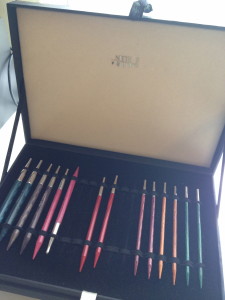
Limited Edition Knitter's Pride Dreamz (well worn!)

Limited Edition Knitter’s Pride Dreamz (well worn!)

I was gifted one more lovely set of needles a couple of Christmases ago. They are a limited edition set of Knitter’s Pride Dreams interchangeable circular needles. They have been so well used for so often (and taken with me when I travel or teach) that the box is starting to show some wear. I love the needles. The cords are nice and flexible and the transitions are mostly smooth. I have a couple of needles that are not as smooth as others. But, over all, this set is a decent price point and they are pretty colors and they are great to knit with.

Needles, like friends, are a personal choice. We all have our favorites or besties. None are “bad”, some are better for different projects. Have you ever travelled with a friend who you can only take in small doses or one who snores? It makes travel a challenge! Needles are the same! When you have the wrong needles, your project will be a challenge. I like to use bamboo with “slippery” yarn (like mohair). I use circulars for almost everything these days but I still like to knit socks on DPNs, too.

Variety is the spice of life, right?

Gone knitting.

Knitt-ah. N. A person who knits (in Maine).

11002596_10153101355569824_32516696716401604_n

I love knitting. I love teaching people to knit.

In my next life, I want to work in a yarn shop or around yarn and teach knitting. I have come to know that I am a really good teacher and I know my craft well. I want to use the passion that I have for teaching and learn more about yarn and fibers. Working in a yarn shop will help me get there.

That next life is coming screaming around the corner on two wheels!

For Sale!

For Sale!

Our home here in Florida is on the market and we are looking forward to moving to Maine. It’s where we feel most grounded. N has had the constancy of the house there in his life for all of his life. We were there are crazy-in-love teenagers. We started our life together with a summer there after our divorces. It is home. The old house is coming down to make way for a very similar house that we can live in year-round. N will be hammering and sawing and nailing. I will be compiling my list of classes that I can teach and going around to meet yarn shop owners to  put it out there that I would like to teach in their shops. I also want to send a note to the LYS shop owner I know whose shop is closest to our house to see if she’d be interested in hiring me to work in the shop part-time and to teach some classes. All of this will be happening sooner than I can imagine. Life continues to zoom past at an increasing speed!

I’m putting it all out there. Being open to the ideas that may be created and open to the suggestions of my peers. I want to visit the markets and fiber events as a blogger and knitter and teacher. That’s where my heart is leading me and I’m choosing to follow my heart.

As our house sale comes together and the move starts to be planned, I am so grateful for the wonderful life that I live. My friends and family who support me (and us.) Life is so good!

Gone knitting.

K1FB Increasing Without Tears …or those pesky little “purl bumps”

This morning I happened across a video for adding a stitch in your knitting without that funny little purl bumpy thing that happens when you knit one into the front and back of the stitch (K1FB). I have gone back to try to find the video but I can’t find it. So, in my own inimitable fashion, I’m going to attempt to show you, dear patient readers, with words and photographs what the video said.

There are many increases to use when you’re knitting. The “quickest and easiest” is K1FB or knit one into the front and back of a stitch. You can use this increase when you see “M1” in a pattern but I’d recommend that you use this as a generic increase rather than a M1 (make one).

When you get to the place where you need to increase, you are going to knit into the front of the stitch (which I’ve already done in the photo below) and then, without dropping the stitch off the left-hand needle, you’re going to knit into the back of the stitch. The photo below shows the stitch that I am adding by knitting into the back … I’m ready to wrap and then slip the stitch off the left-hand needle.
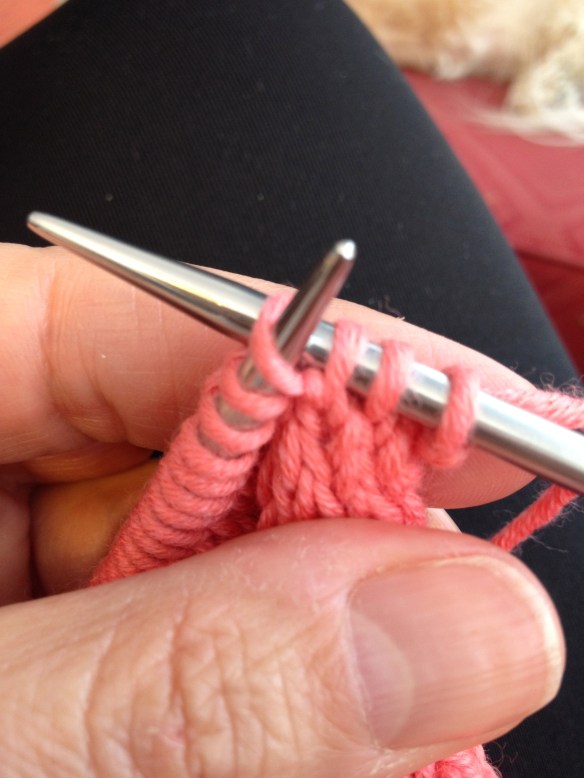
I've knitted two stitches and am knitting into the front and back of the third stitch. I've already knitted into the front and now I'm knitting into the back.

I’ve knitted two stitches and am knitting into the front and back of the third stitch. I’ve already knitted into the front and now I’m knitting into the back.

OK, so, I’ve wrapped the yarn around the working needle and slipped the stitch off the left-hand needle and this is what it looks like. There are my three “old” stitches and my “new” or “added’ or “increased” stitch. (Remember the first stitch is the the one to the right in the photo. The added stitch is the left-most stitch, the stitch just worked.)
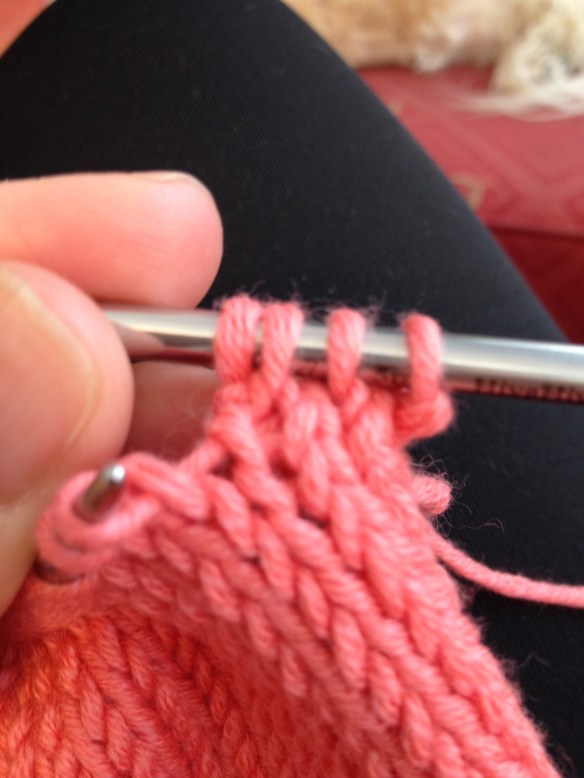
Three stitches is now FOUR! But can you see the "purl bump" on the fourth stitch (the left-most)?

Three stitches is now FOUR! But can you see the “purl bump” on the fourth stitch (the left-most)?

So, we’ve accomplished our goal which was to increase one stitch. That stitch, however, isn’t invisible because of the little purl-like bump that is sitting in front of it. There’s nothing you can really do about it. And most times when you increase using the K1FB method, you’ll be increasing close to the side of a garment and those stitches will be swallowed up in a seam and will be virtually invisible after seaming.

BUT there is a way to make the stitches less visible and this is how you do it!

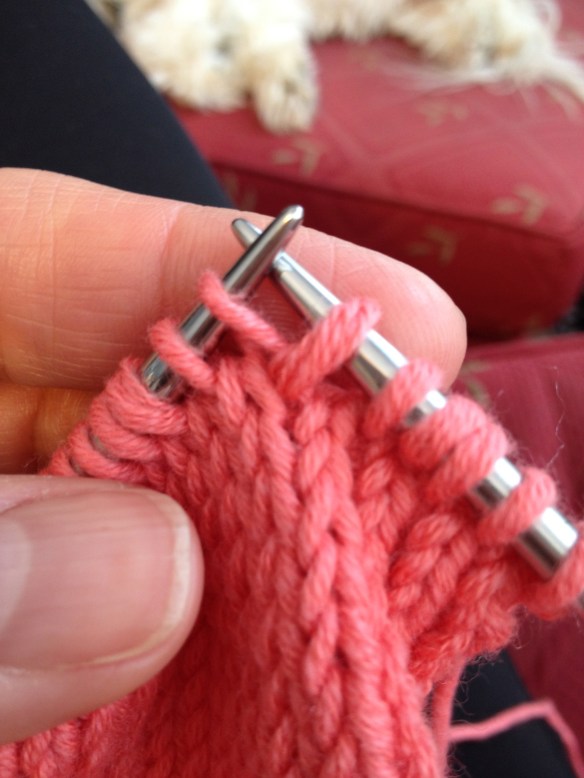
The first step is to knit into the front of the stitch but (again) don’t slip the stitch off the left-hand needle. (This is the exact same as the K1FB that I illustrated above.)
IMG_4271

When you get to the stitch where you want to increase, knit into the front of the stitch.

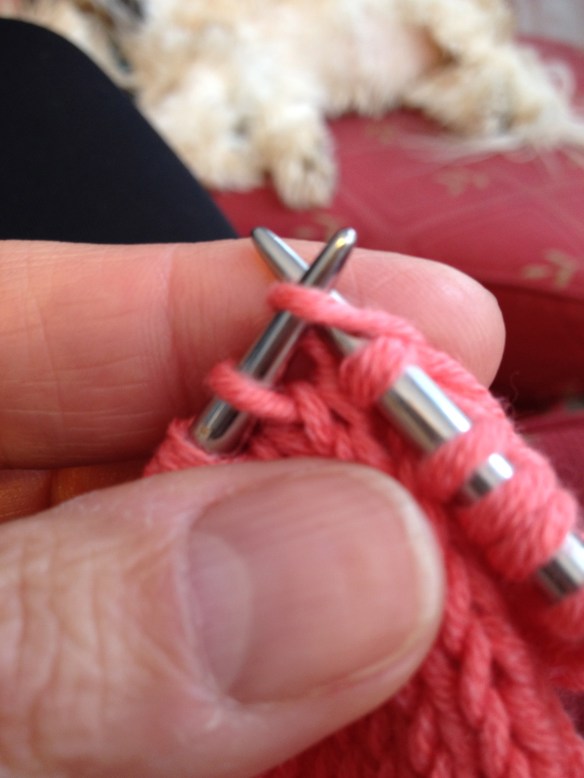
The second half of the stitch needs to be reoriented so that the stitches don’t wrap around the front of the work. So, you’ll slip the next stitch knitwise by inserting the tip of the right needle from left to right (just like you were knitting the stitch) and slip the stitch from the left-hand to the right-hand needle.
IMG_4273

Next, insert your working (right-hand) needle into the front leg of the next stitch to be worked on the left-hand needle knitwise.

I know it sounds confusing, but I am at a disadvantage not being able to film myself in a video here! It forces me to find the right words to explain the process clearly and that’s good for both of us!

Next you’re going to slip the stitch back onto the left-hand needle to finish the process. Insert the tip of your left-hand needle purlwise into the stitch you just slipped to the right needle. Slip the stitch back to the left-hand needle.

IMG_4274

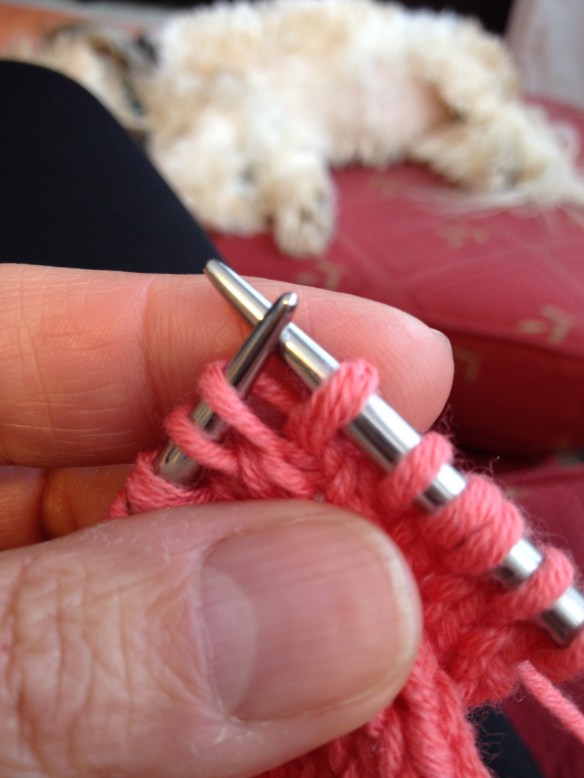
Slip the stitch purlwise back to the left-hand needle … you’re almost there!

All you’ve done is slipped the second part of the stitch increase from the left to the right knitwise (as if to knit) and then back from the right to the left purlwise (as if to purl). This has reoriented the legs of the stitch so that when you (next!) knit it, the stitch isn’t wrapped with yarn (and it doesn’t look as much like a purl bump.)
IMG_4275

This is how your reoriented stitch looks … and now you are going to knit it.

Go ahead, knit the stitch and slip it off the left-hand needle. There! You have increased one stitch.

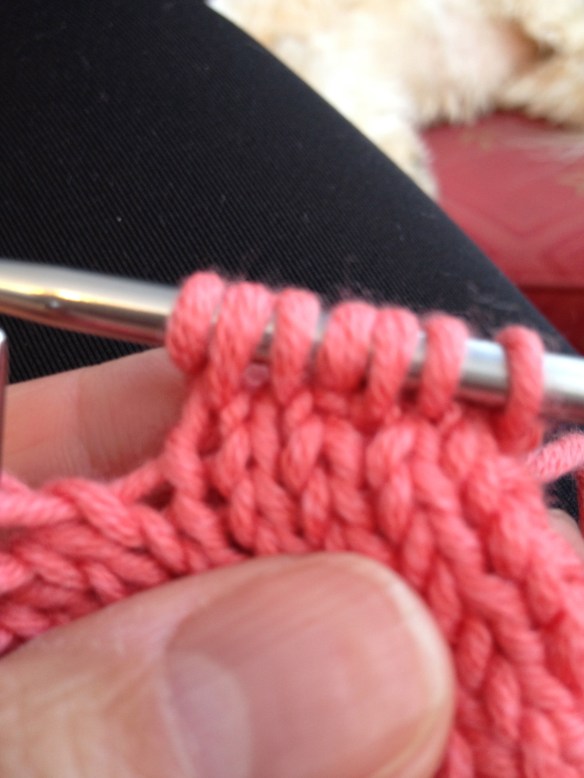
If you look at the next photo now, you’ll see that there is a “normal” K1FB increase and a K1FB increase where I’ve changed the orientation of the increased stitch.
IMG_4276

Reading from right to left: K2, K1FB (the old way where it looks as if the fourth stitch has a purl bump), K1, K1FB (the new way with changing the orientation of the increased stitch.)

See! No purl bump thingy! Now I’ll purl back across the stitches and you can see the fabric again …
IMG_4279

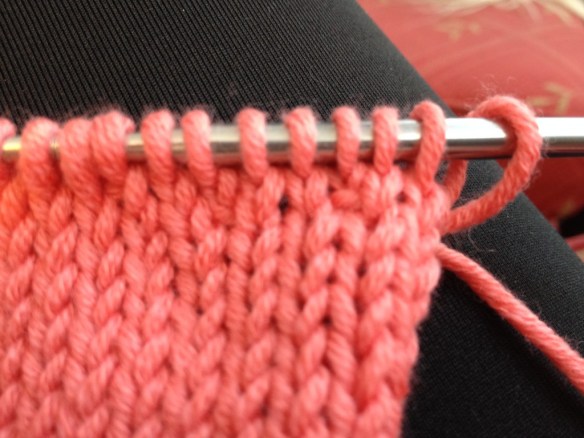
Again, reading from right to left you’ll see three knit stitches, one knit stitch with the “purl bump” below it and another two knit stitches and a new stitch from our reoriented K1FB.

There you have it! Two ways to increase in your knitting with K1FB (knit one front and back).

The first increase in stitch #3 (read from right to left) was the “old” knit one into the front and back of the third stitch which creates a fourth stitch with a “purl bump”. This is an excellent way to increase! Super quick and easy, just a bit visible in some circumstances.

The second increase in stitch #7 is done similarly but with a little twist of the second half of the increase where we reoriented or changed the orientation of the stitch before knitting it. This creates an added stitch without a wrap or “purl bump”. It’s pretty cool, isn’t it?

Learning to read your stitches is essential to your success as a knitter. I’m getting more skilled at it every time I take on a new project and teaching has helped me tremendously. This photograph, however, is such a clear one … and I get all excited.

When looking at this last photo, I can see the stitches added! Take a good look. The stitches in a each row are all lined up like a v on top of a v. Nice and neat! You can follow the stitches up in the center of the v. Where the increased stitches are added, it’s a little bit squeezed and the pretty symetry

VVVVV

VVVVV

VVVVV

When we increase a stitch, it squishes an extra stitch into the nice neat lines.

vvVvvVV

VVVVV

VVVVV

It’s a good attempt to illustrate with my limited illustration skills. I think. 🙂

Now that you’ve seen my excellent illustration, go back and have a look at the last photograph (I’ve added it below for you). Start at a stitch on the needle and follow the “v” down the rows. See how they line up? And can you see where the increased stitch just kind of pops up out of nowhere? It doesn’t have a nicely stacked column of “v”s to sit on top of … it’s just out there. The first K1FB increase (with the “purl bump” below it) stands out a lot more than it’s “cousin” the second K1FB “with a twist” but similarly, it just kind of gets nestled in between two stitches … each of the stitches has its column of “v”s but the increased stitch is sitting out there without a column. Can you see it now? Isn’t it exciting? You’re reading your knitting!

IMG_4279

Read your knitting!!! Stitches are sitting in a column of “v”s; row sits squarely on the row below it … until you have an increased stitch!

There you have it! How to make a K1FB increase without having that wrapped stitch that looks like a purl bump. I am such a knitting geek!

What else do you want to learn about increases?

Gone knitting!


And they’re D. O. N. E.!

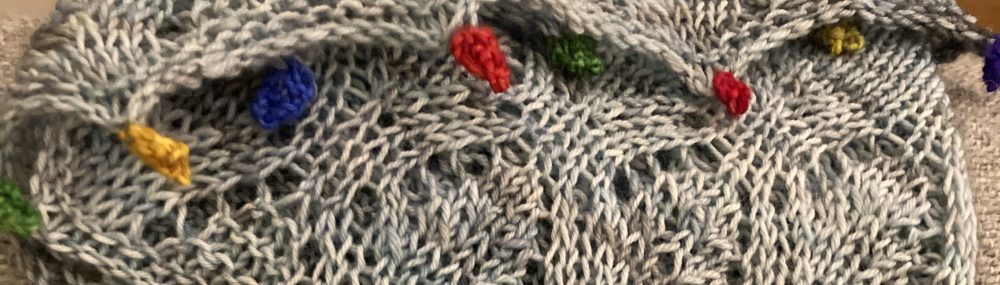
Three projects hit the finished projects file today. It feels good.

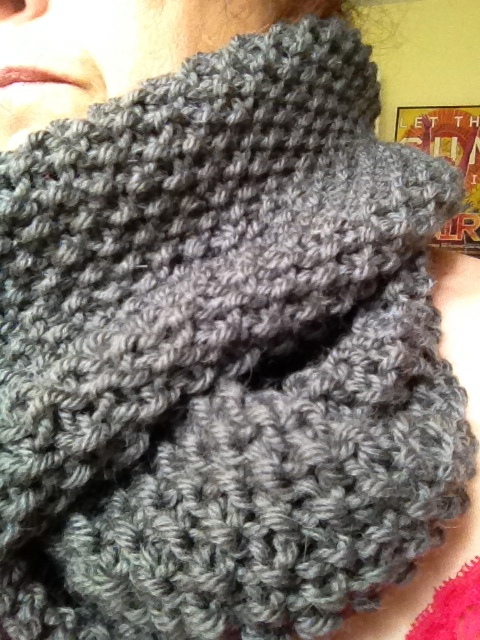
My daughter in Chicago asked me to make her a cowl in a dark gray, chunky yarn. I found her a lovely gray bulky merino and alpaca blend (Knit Picks Cadena) in the Kestrel colorway. The pattern wants three skeins of yarn and knits up really quickly. Of course, it’s bulky yarn! I think she’s going to love it. And it didn’t break the bank. The pattern, free on Ravelry, is the GAP-tastic Cowl. Knitting it is super simple and no seams. You cast on a bazillion stitches but it’s a short knit! It can be worn singly or wrapped double. A fun cowl – and one that I was honored to knit at her request. (She’d seen a bulky cowl in a store and thought that since it’s my business, knitting, she’d ask me to make her one!)

Gaptastic Cowl in Knit Picks Cadena, Kestrel

Gaptastic Cowl in Knit Picks Cadena, Kestrel

The seed stitch fabric is just lovely … and it feels nice and soft with the addition of the alpaca fiber.

IMG_2446

Next, I finished her headband.

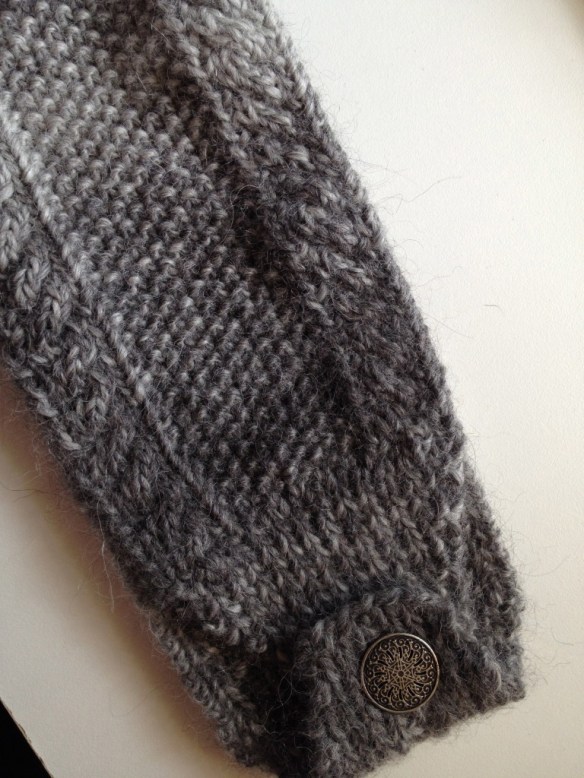
The pattern that I used was a cabled headband, “Green Forest”. I love the seed stitch (matches the GAP-tastic cowl) and the cables. I normally would make a cabled pattern with plain yarn as the alpaca sort of softens or makes the pattern less visible but I wanted to use this yarn! So, I did. And I’m pleased at the success. I think she’s going to love wearing the headband in Chicago this fall and winter! OK, maybe fall. I added a second button hole so that she can tighten up the headband if the alpaca yarn stretches a little bit. And I made her headband 32 repeats of the 4-row pattern. I think I will have to make another one for my sister-in-law in Massachusetts.

Green Forest cabled hea

Green Forest cabled headband

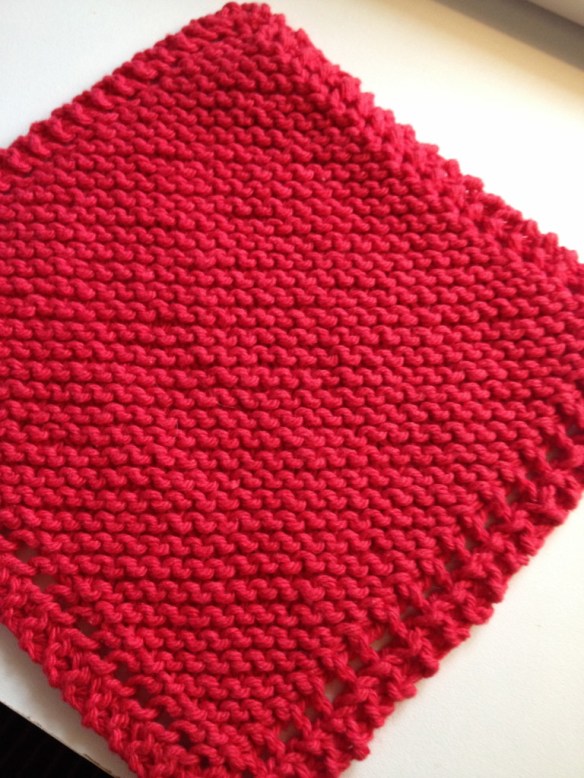
Last, but not least, is the sample dish cloth that I made to teach a new bunch of knitters at work. Or at least my boss! She wants to learn to knit because she wants to knit dishcloths! I think it will be a riot and a half teaching my wonderful boss. And an added bonus will be if any of the other staff choose to join us! It has also given me a great idea for Christmas gifts for my co-workers! But, suffice it to say, it’s a secret for now!

Basic (easy) Dish Cloth

Basic (easy) Dish Cloth

I know I haven’t been blogging much since I started working and I haven’t really been knitting that much either. Life has taken on a different turn for now and I am quite satisfied by the way it’s going. I love my job and the people that I am working with. It’s already November! A couple of weeks and we have a long weekend for Thanksgiving and then before we know it, we’ll have several weeks off for Christmas! Before we know it, I’ll be heading back to Maine for the summer.

I’d rather be knitting … in Maine any day! Can’t wait to be on my summer porch!

Gone knitting!

Great Class & Frustrating WIPs

I feel badly that I am not knitting and blogging more but my days are quite full with my “new” job and life after work. So, the blogging and knitting have taken a back seat for now.

I had a great sock class at The Black Sheep this morning. Five students took on the “Lesser Evil” socks pattern, learning the Magic Loop technique and a Turkish cast on at the toe. Two of the five left class with two toes all ready for knitting the foot. The other three were also well on their way to success with this pattern. I do love teaching knitting and I love sharing new ideas and ways of thinking about knitting with people. It’s supposed to be fun, too!

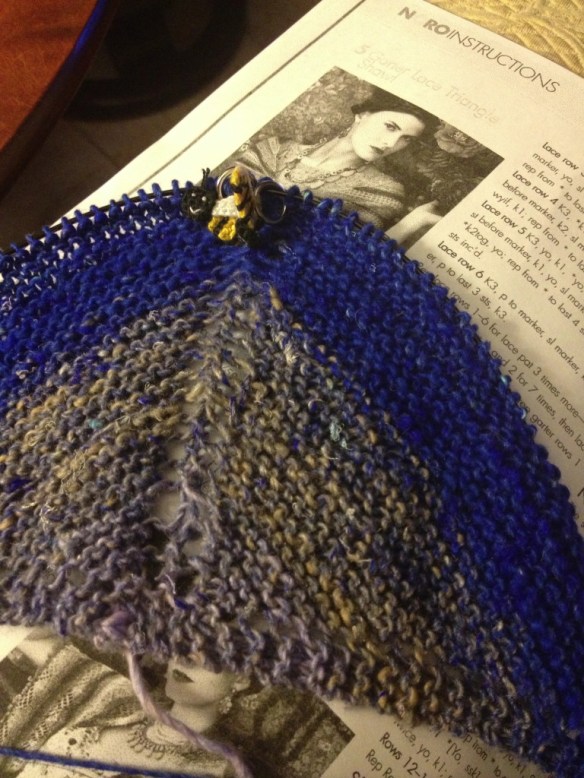
Noro Shawl

Noro Shawl

My knitting projects (WIP=work in progress), however, are far from satisfying. I have decided to frog the Noro shawl and use that beautiful Noro yarn to knit up a Bermuda shawl. I am not thrilled with the pattern from the Noro magazine after all and would rather have a light colored, colorful shawl/scarf that I love. So, I’ll be frogging later today.

I have all the pieces knitted for the French Press Knits Felted Slippers. And when I use all my seaming experience it still looks awful.  I know, intuitively, that the felting will make all sorts of flaws disappear. But, for goodness sake, it shouldn’t be such a battle. For today, I’ve set the pieces and the pattern aside and I’m going to tackle it again another day.

I am waiting for yarn to come from Knit Picks (duh! I somehow sent the yarn to the house in Maine instead of the house in Florida where we actually live most of the time … and where we are now!) Fortunately, I caught it and Knit Picks has re-routed the yarn to Florida (think it was Freudian?) I am looking forward to making the Gaptastic Cowl for my daughter in Chicago.

I have signed up for the 30-day Sweater Challenge. Not sure how I really feel about the project considering my time constraints BUT I may have a look and see what I can come up with.

And lastly, I have the fingerless gloves, Composed Mitts, that I found on Facebook and happened to have the pattern in a 2007 issue of Interweave Knits. The yarn is beautiful and if I could decide that I like the bobbles on the cuff edge of the mitts, we’d be in good shape. I have already tried starting the pattern twice: once knitting the pattern as written and once knitting the pattern using Annie Modesitt’s bobbles. I didn’t really like either one. Perhaps a picot cuff edge?

I have N’s slippers to be felted, too … since mine are being set aside, perhaps I should go ahead and felt his rather than waiting for mine. Or maybe not. 🙂

Gone knitting.

End of the Year. End of the Job.

It’s been a whirlwind 50 days as an ESE FCAT Tutor. When I applied, who knew what a wonderful experience it would be!? I’ve joined a wonderful family at Woodlands Elementary School and I’m so thrilled to have been able to work with the students, teachers and staff there. Even for only 50 days.

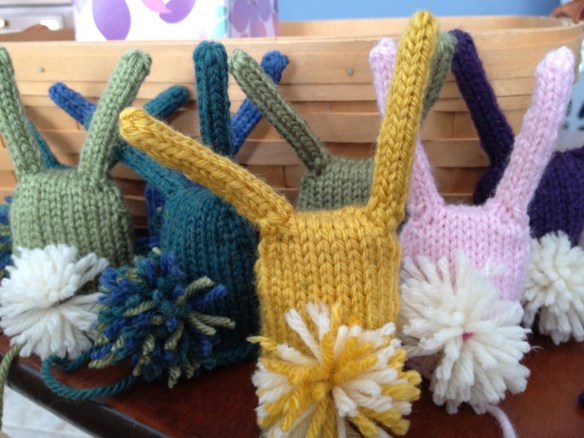
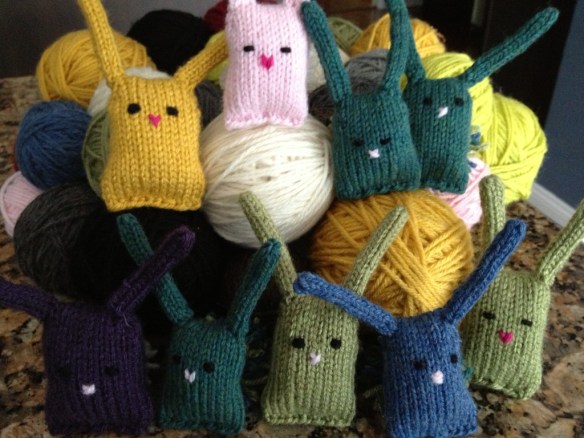
I have been thinking about whether and what to do about end of year gifts for “my kids” and I decided this weekend to make a few more of Rebecca Danger’s “Bunny Nuggets”. One for each of the kids (and one for my two teachers, too.) A little something to remember me by.

Body Parts

Body Parts


It all starts with knitting the body parts. Quick to knit and I used up a bunch of stash yarn in the process as well. The pattern, free on Ravelry, I’ve given you on my blog before. But they’re so cute, I’m providing the link for you again!

Add faces

Add faces


When the body parts are all knitted up, you can assemble them. Assembly is easy. Add a little face and sew on the ears. You also have to make a little pompom for the tail.

I don’t have a pompom maker, if you have one, use it. I use a scrap of cardboard around which I wrap the yarn (about 45 wraps per pompom) and then using my darning needle strung with yarn, I tie a tight knot around one end of the yarn. If you wrap the first half of the knot around twice instead of once, it holds more tightly and won’t loosen when you go to make the second part of the knot. Tight knots are imperative when you’re making pompoms.) Trimming the pompom is messy but I love a well-shaped pompom. I made some of mine cream-colored and some multi-colored. Just for fun! The third grade boys all got the same three-color pompom tail … because I wanted them to remember that they are in this world together. Friends should always remain friends.

Pompom Tails on the Nugget Butts

Pompom Tails on the Nugget Butts


Once the ears, faces and tails have been attached, you can stuff your nuggets. I have used scraps of yarn or quilt batting or cotton balls or fiber fill … whatever I have around the house. Now it’s time to sew up the bottom seam and they’re all done.

Eight little Bunny Nuggets will be packed up and handed off to my eight new family members. Who knew that in 50 days, I’d feel so close to these kids and their teachers. I think being an ESE FCAT tutor was one of the best jobs I could have had. I hope I’ll be able to find something that feeds my heart and soul in the fall!

Bunny Nuggets ... ready for the end of the year!

Bunny Nuggets … ready for the end of the year!

Gone knitting!