How to Weave in Ends as you Knit!

I just completed a pair of wonderful striped Christmas stockings. They are beautiful – but they had a bazillion ends that needed to be woven in at the end of the project
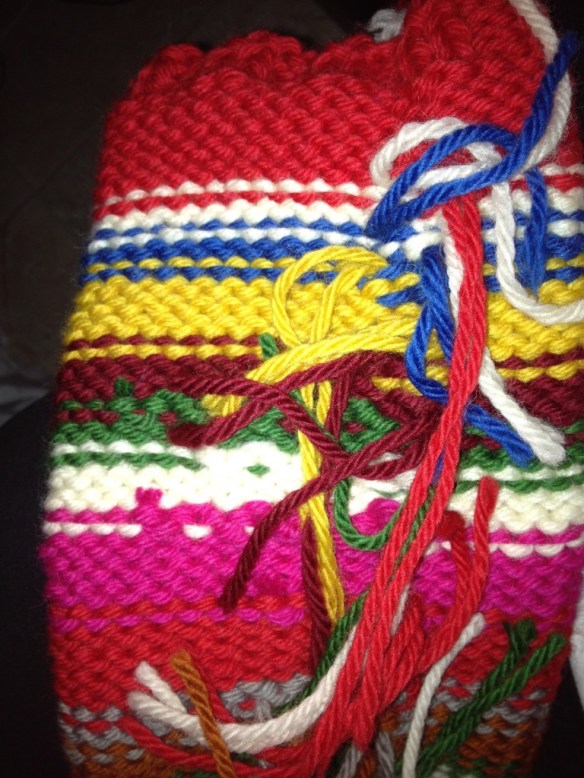
At least a bazillion loose ends!

… unless you knew this trick!

You can weave in the ends as you go and avoid the drudgery at the end! (It’s a bit like avoiding seaming by learning to knit in the round!)

So, “how do you do it?” you ask? Here’s how.

When you’ve knit to the place where you need to change colors or yarns, you can make your first stitch with the new yarn. And what you’re going to do is ” carry” the yarn to be woven in (the old color of yarn) across the next row of stitches by alternatively bringing the old yarn tail up and over your needle and knitting a stitch and then bringing the tail down and knitting a stitch.

Here are a couple of illustrations:
IMG_0815

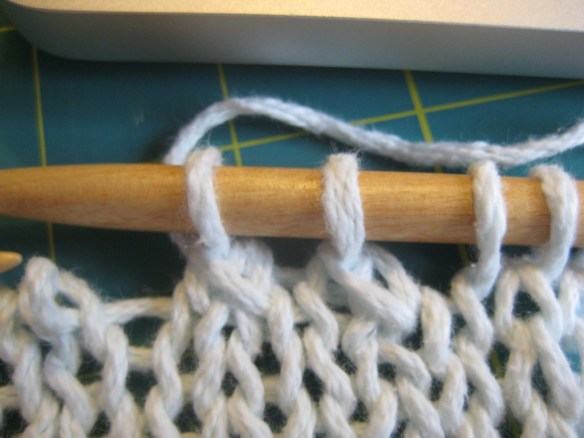
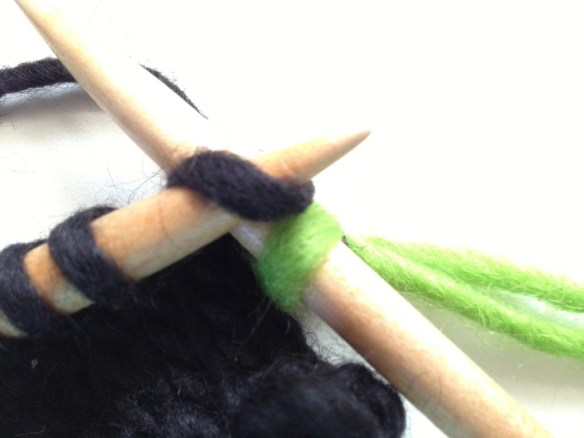
On right is first green stitch. Making stitch #2

Making the second stitch of the first green row of stitches by inserting right hand needle into the second stitch knit-wise.
IMG_0817

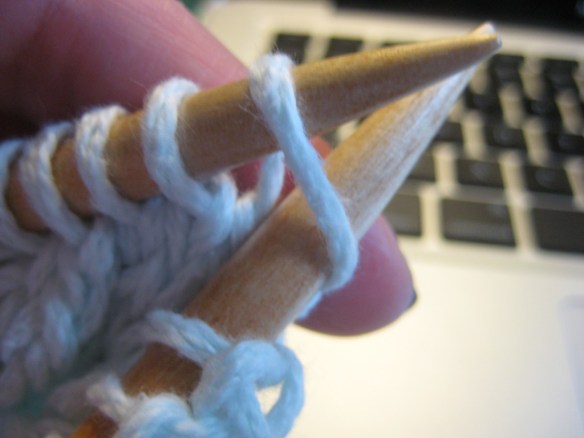
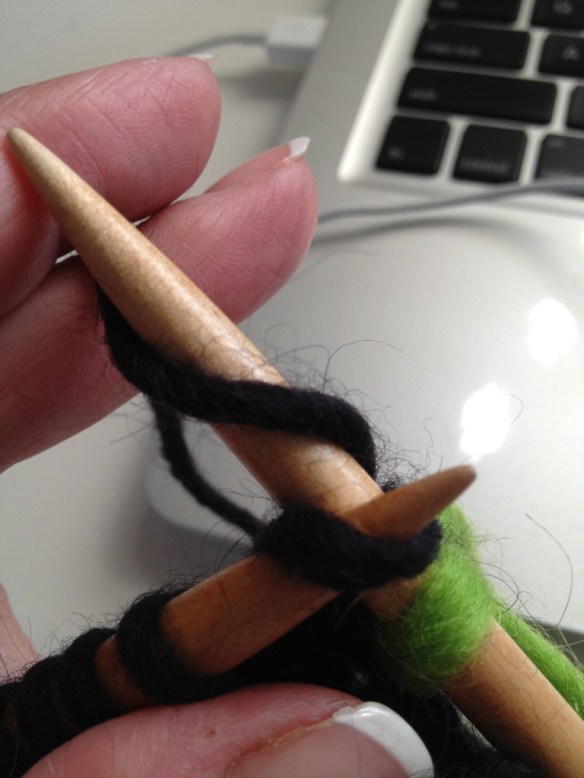
Carry the yarn tail

Bring the yarn tail to be woven in (the black yarn) across the stitches. First bring the tail up over the needle and then wrap your new yarn around the stitch to be made.
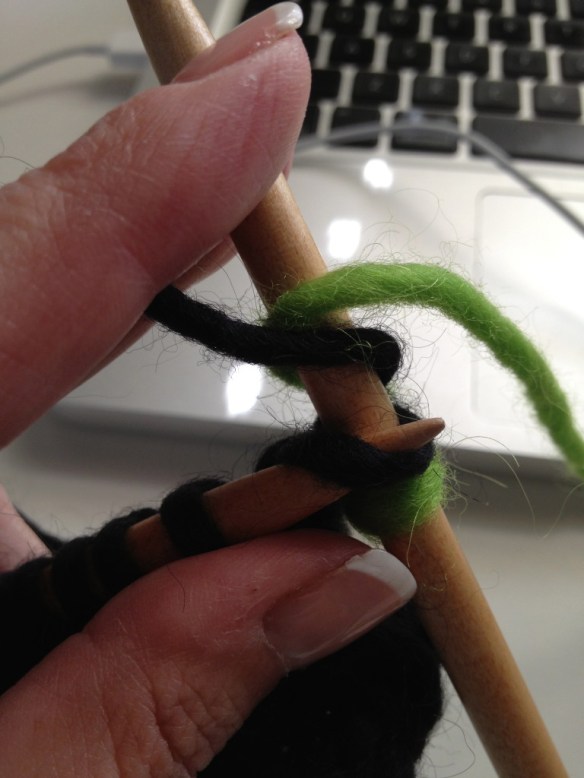
IMG_0818

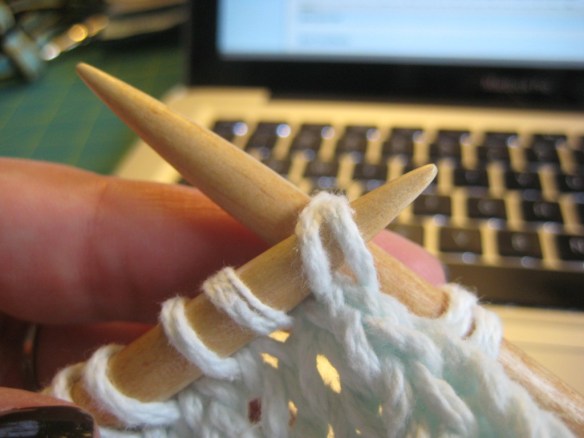
With tail over the needle, wrap your new yarn around the needle to make the next stitch (green)

Bring the tail back down and then finish your stitch.
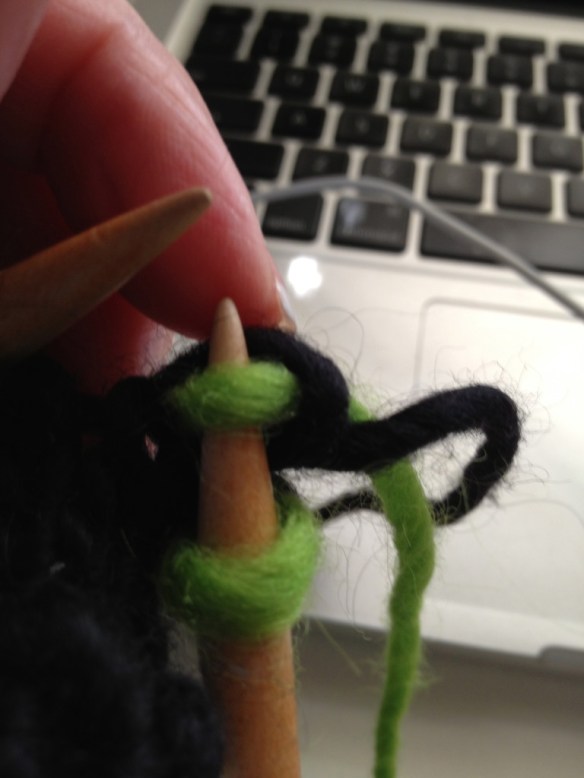
IMG_0820Make the next stitch “normally” with the tail being held down so that your yarn is carried over the tail yarn (black) when you make the stitch.

Alternate bringing the tail yarn over the needles and holding the tail yarn down while you make the next four or five stitches. That should be enough to hold the tail. You can finish your row and cut the tails close to your stitches.
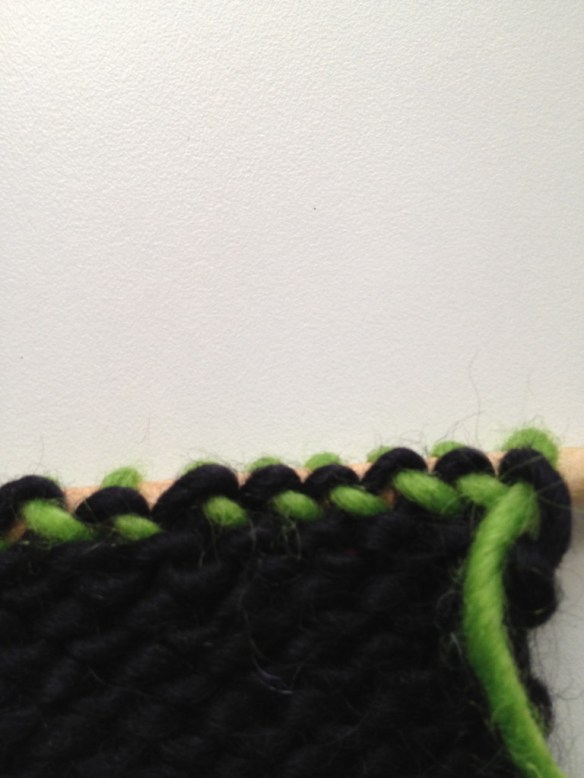
IMG_0822

The tail is woven in and doesn’t even show – unfortunately, I chose black yarn so you really can’t see the tail!

I hope this helps!

Gone knitting!


Annie says … On slipping and decreasing

I “promised” way back when (I took the weekend courses with the wonderful, beautiful, talented, Annie Modesitt) to post some tips that I gleaned from the classes. There were so many wonderful bits that she offered and, today, I’d like to share a couple of those with you!

Tip 1

When asked to slip a stitch, the default is always to slip the stitch purl-wise by inserting the right needle into the stitch to be slipped from the right to the left in front of the left needle.

Insert right needle as if to purl (from right to left in front of left needle) ... OMG, my thumb has dry skin!

Tip 1.1

Annie attributes the following tip to her friend Sally Melville (I have all of her books. Now, it’s time to actually read them rather than looking at the pretty pictures and reading snippets!)

When slipping stitches: if you’re going to use the stitch again in the same row, slip the stitch knit-wise. If not, slip the stitch purl-wise (the default, see tip 1).

Tip 2

Annie has her way of decreasing down to a science. When you want to decrease with stitches leaning to the left, you would “typically” be told to “SSK” or “slip, slip, knit”. To do this you slip one stitch from the left to right needle knit-wise as if you were going to knit it (see tip 1.1), slip another stitch from the left to right needle knit-wise and then knit the two together (bring the left needle through the front of both stitches on the right needle, wrap the yarn as if you were knitting, slide the new stitch on the right needle and slip the two old stitches off the left needle.)

Slip - Insert right needle into stitch from left to right as if to knit

Knit - Insert left needle left to right into the front of the 2 slipped stitches

An easier way …

SSK is very manipulative (to the stitches, anyway!) The more you manipulate the stitches, the more likely they are to get stretched out. So, you end up with the same thing if you K2togTBL (knit two together through the back loop) or as Annie writes it K2togL (knit two together left). To K2togTBL, insert the right needle through the back loop of two stitches, wrap the yarn as if to knit, slip new stitch onto the right needle and the two old stitches off the left needle. One stitch decreased. The decreased stitch leans to the left.

Insert right needle through the back loop of two stitches

Another way to think about this (decreasing to lean either left or right) is to watch your needles.

A K2tog (Annie would write this K2togR) will lean to the right (in the direction of the direction of your left hand needle) …

K2tog - right needle points to right ... decrease will lean right

SSK or K2togTBL or T2togL will lean to the left … again, watch your needles!

K2togTBL - Right hand needle is pointing to the left, decrease will lean left

The final result … whichever way you choose to make a decreased stitch … is the same. Look at the first two (on left side of needle) stitches. One is a SSK and one is a T2togTBL.

After ... two left leaning decreases (one on l. is K2togTBL, on r. SSK)

Tip 3 and Tip 4

Totally unrelated to knitting except for the fact that it’s about a knitter.

Annie uses Bare Escentuals Bare Minerals make up. I’m going to look into it because I love the idea of sunblock being in the makeup!

She also loves to knit on Signature needles. I’m coveting my first pair and will report on their beauty when the gift fairy brings me some.

But for now, I’ve gone knitting!

Fun and Games – Random Stripe Generator

I found this wonderful knitting tool on a blog. (Does anyone else get lost following from one blog to another around the Internet?) Anyway, I digress …

I found this wonderful knitting tool on Caitlin’s blog (biscuitsandjam dot com) and it helps you create a random stripe pattern for your knits. If, for example you’re knitting a striped scarf, you can click on the colors of yarn you want to use and the number/numbers of rows in each stripe that you want to have in your scarf and the random generator shows you what your scarf will look like.

Better yet, if you don’t like the first pattern, refresh your screen and it will show you another and another and another until you love one. Scroll down and there’s your pattern! Marvelous!

Here’s the link to take you (magically) to biscuitsandjam dot com’s random stripe generator … have fun playing with stripes! And a big thank you to Caitlin (in Portland, OR) for the tool. And the fun blog!

Annie-isms … The Rules

So, having paid for the weekend with Annie Modesitt (reasonable though it was!) I thought I’d milk it for all it’s worth! Get it? … Milk it? … Cow? (Supposed to be a joke … my kids always told me I’m not funny but I know that I can be. LOL!)

Love!

There were several knitting tips and life tips that Annie imparted to our group along the way and I wanted to share some of them with you. Because you deserve it. And because I think so often that things that apply to knitting also apply to living.

Ponder this:

Annie’s Three Rules

#1 – I’ll tell you later (Yes, this is what she said … not kidding!)

#2 – During class, I (this is Annie speaking, not me … although the rule is so appropriate for a classroom setting, I may just steal the rule!) should be the only one talking.

#3 – Don’t rip out the knitting that you’ve done in class. It’s hard to do a post-mortem without a body in the room.

And her number one rule … are you ready for it? Drum roll, please …

Don’t say anything about yourself that you wouldn’t want your daughter to say about herself (that you wouldn’t want to hear your daughter say about herself).

Saying negative things about ourselves only brings us more of the same.

Conversely, saying positive things about ourselves only brings us more of the same.

Interestingly, I found this on one of my Facebook favorites this morning.

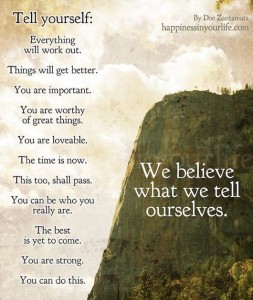
Acting As If (with credit to happiness in your life dot com)

It’s a relatively new favorite page, but a favorite all the same. Primarily because it’s all about being positive – and I believe that you have to act as if … we believe what we tell ourselves … and if we tell ourselves positive things, we’ll attract more positive to our lives and we’ll be happier. Sounds easy, right?

One of my college friends reminded me that this was similar to the way that Abileen (think the book/movie ‘The Help’) talked to the little girl that she cared for because she never heard it from her mother. So true! That little girl (or boy, let’s not discriminate) needs to hear our mother tell us we’re special. That first intimate relationship with another human being is so important for our emotional and personal development and it’s crucial to becoming who we really are. And because so many of us didn’t hear that from our mothers, we can heal that inner little child by telling ourselves things we need to know.

So, for today, I’m practicing telling myself positive things. Anything practiced can become a   habit – and I really believe that this will bring even more happiness into my life.

Gone knitting!

The Money Tree (?)

Money doesn’t grow on trees.

I had a discussion with my brother the money manager today. He’s a wise man and I was encouraged to see what I could find out about the banks that I am using and which banks might be more sound going forward.

Visit Bankrate.com and check out the ratings of banks nationwide. They have a rating system (“safe and sound”) of 1 to 5 with 5 being the best. Any rating of 3 or above means that the bank is “performing” … call me crazy, I’ve worked hard for my money (what there is of it) and I’d like to have it be in a bank that has a 5 rating.

Visit Safehaven.com to read an article about whether your bank is safe. I’ve ordered a report from Veribanc and I’ll let you know what they say and, particularly, if it’s any different from the rating from Bankrate.com. Could be rather interesting! This Veribanc report suggested by Safehaven.com costs $25 … here’s my reasoning … it’s totally worth the money to make sure that my (soon-to-be) bank is on solid footing!

So, there you have it. Obviously, I’m not a money manager  – I’m a knitter, a Queen Bee! – and I can’t give you financial advice (and if I did and you took it, we’d both be fools!) BUT, what I can suggest is that we all start taking some responsibility for ourselves and our actions. Let’s start with our pocketbooks! Know about the financial institution that you’re entrusting with your hard-earned money! And if you don’t do the work, shame on you. (There, I said it.)