Not Knitting but Grateful

My new school - teaching on a beautiful day!

My new school – teaching on a beautiful day!

Well, I’ve once again joined the working world with a temporary job outside of my home.

While I am enjoying working with children in the elementary school environment, I am noticing that I am not knitting enough to feed my passion and art. Partly because at the end of the day I am pretty tired and partly because I still have all my work at the house to do, too. And my little dogs (and now our new big dog) have missed me and need some of my undivided attention … as does their “father”!

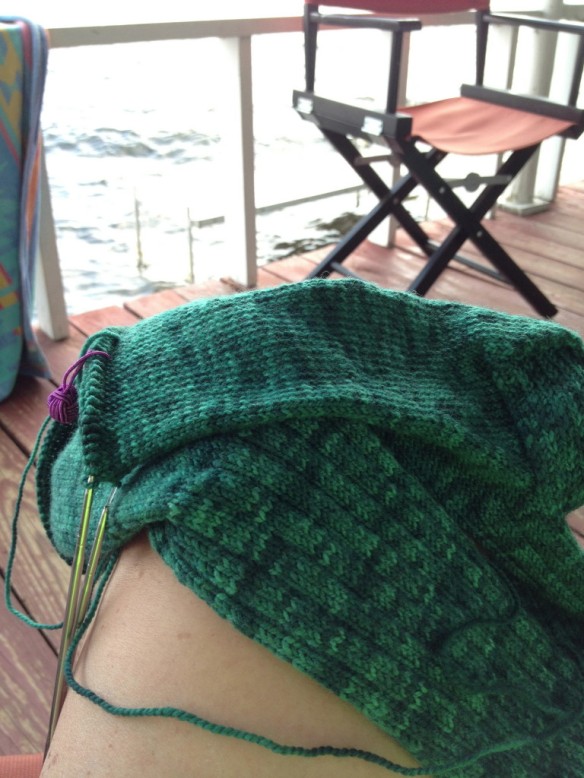
I have a pair of socks for my nearly 50 year-old brother on the needles. I reverted to my favorite (go to) sock pattern and have had some lovely green (with a hint of blue) yarn that I bought for exactly this reason last summer. His favorite color is green and this yarn by Plymouth Yarn Co. called “Happy Feet” is a superwash Merino and with my brother’s feet, I bought three skeins (he wears a size 14 shoe!)

Seacolors Yarn

Seacolors Yarn … 

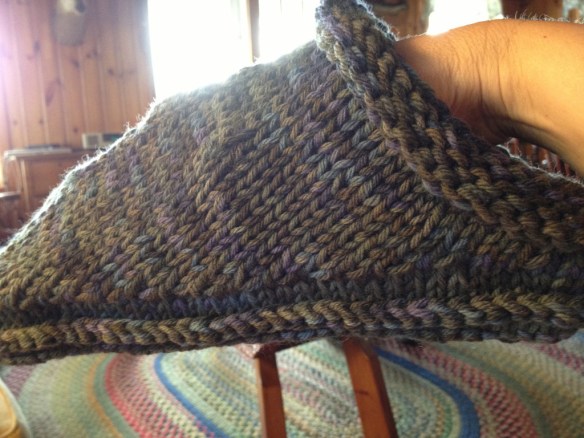
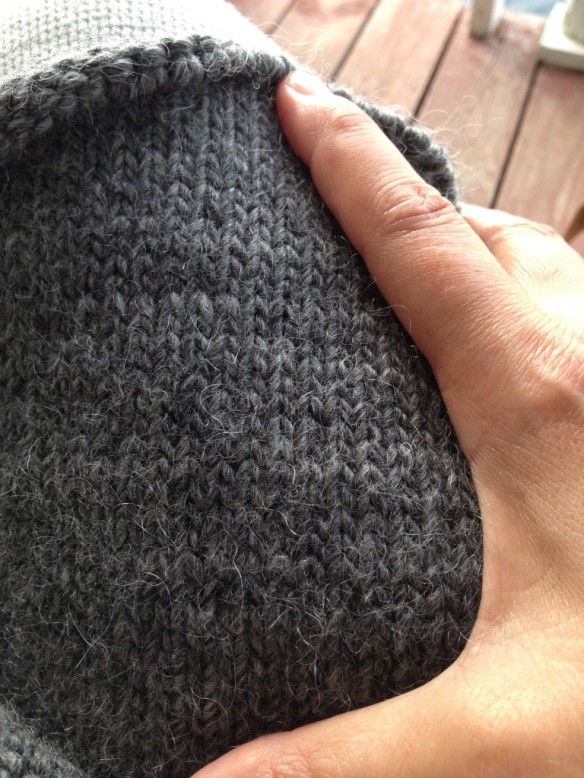
I have deconstructed the sleeve on my Boxy Cardigan that I started last summer with my Maine wool from Sea Colors Yarns. The pattern was pretty straight forward but someone clearly forgot to have the sweater test knitted – the sleeves are at least two inches too narrow to fit into the shoulder. (You do get what you pay for! This was a free pattern. Lesson learned!) I will unknit them and then add more increases to make up for the two inches and see how that works. I hope I don’t have to start over from scratch because I don’t like it – and I spent a lot of money on the wool and want to love the garment that it becomes!

Dropps Tunic (Pattern #111-21) in Berroco Pure Pima (color 2243)

Dropps Tunic (Pattern #111-21) in Berroco Pure Pima (color 2243)

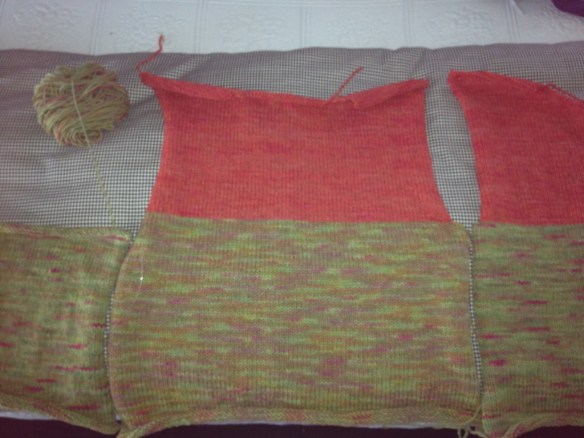
I still have my Pima Cotton tank on the needles. The back is done and the front is getting close but, honestly, I haven’t worked on it much at all! It’s really time to focus on this garment as we’re getting ready for that sleeveless shirt season!

I have several ideas that I want to knit when I’ve wrapped up a few of my WIPs … a tea cozy by the Queen of Tea Cozies, Loani Prior … it’s the daffodil one. We don’t have daffodils here in Florida and I miss them. A Stash Buster Shawl and I have yarn for a sweater and hat for my niece. I also want to knit myself a Wonderful Wallaby! It would be perfect for those cool (or even cold) evenings in Maine this summer.

I’m so grateful to be working with these great kids who really need the extra support to bring them up to grade level by the end of the year. I love the teachers that I’m working with and I am blessed to have the opportunity to work close enough to my home that I can (well, I could) walk to work. And since it’s temporary, I am hoping to pick up the needles more when I get to Maine after school ends.

Gone knitting!

Wonderful Wallaby – Pattern Review

Image 4I taught the Wonderful Wallaby pattern by Carol A. Anderson as part of the classes that I offered at the Yarn Nook in Lafayette, LA earlier this month. This pattern is so great that I want to make one for myself (and so did the owners of the Yarn Nook … another uniform piece?)

The pattern reads a bit like a story and has cute illustrations. I had a bit of difficulty finding the place in the pattern booklet where they told me what I needed to get gauge and others did, too. But it is there. You may have to “hunt” a little. Once you’ve gotten your gauge swatch knitted and are set to begin, the pattern is clearly written and well written. I have had no difficulty following most of it. I did do and re-do the part where you pick up stitches at the bottom of the “pouch”/pocket. If I had actually READ the pattern, however, it would have been done properly the first time!

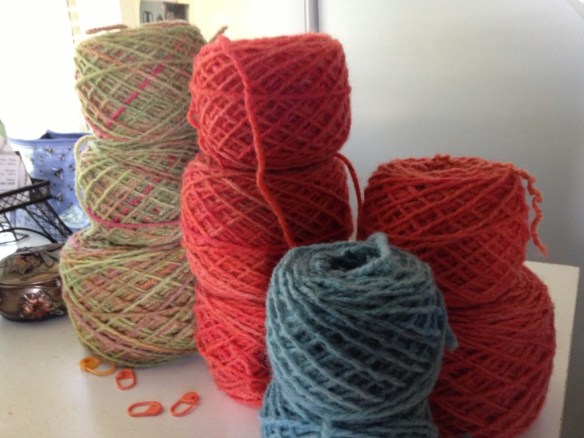
I decided to add a bit of a different yarn to my sweater (I knitted the smallest size, a 2T) and make the pocket/”pouch” a different color and I also started the sleeve ribbing in the coordinating yarn. Once done with the body of the sweater, I also decided to use the coordinating yarn for the collar ribbing and on the 5 stitches that border the hood. I wish I had added the coordinating yarn at the first row of the neck stitches in the yoke. (For the children’s sweater, this direction is on page nine at the bottom.) I’d have begun the coordinating color yarn at the place where you purl the ten center stitches between the markers on the front of the sweater.

Students who took this class made good progress and each sweater was very unique. One student was making a green sweater with a pink pouch. Another was making a baby blue sweater with blue and pink stripes on the pouch. They were all cute! One poster on my Facebook pages said that this was her favorite children’s sweater pattern ever. I might be willing to agree with her after knitting this pattern.

The yarns that I used were Berroco Comfort Solid in a beige color (3 skeins for my size) and Classic Elite’s Liberty Wool in a beige/lavender/grey/green colorway. I love knitting with both yarns on this sweater. The Berroco yarn is not too heavy and is washable. It’s worsted weight and not too “splitty” (my pet peeve for yarn!) I think for a child’s sweater, it has to be washable … what mom wants to wash their child’s sweaters by hand? As with all knitted items, I’d suggest drying it flat. Liberty Wool is a soft wool yarn and I love the colorways. I wanted to take home a couple of balls of each just to play with. This yarn is a looser wrap and can split so be careful knitting with it but you’ll love the way it feels. And the way it looks, too!

I am totally pleased with my Wonderful Wallaby and will be sending it on to a very special little girl in our family … she’s going to have a bunch of hand-knit sweaters from her auntie when she is a little bit bigger! Her collection keeps growing … because I keep finding sweet little patterns to knit for her! I have another project all lined up for when I finish one or two!

You can purchase the pattern at your LYS (local yarn shop) or online at Amazon.com or Cottage Creations. You can also call Cottage Creations at 641-324-1280. The pattern is around $7.00 … a great deal considering you get from size (child) 2-T through an adult XXL or “super size”! Trust me, you’re going to want to knit one of these for every member of your family! And don’t forget to check out the different styles and colors that have already been knitted on Ravelry!

Gone Knitting!


More from the Yarn Nook

I have promised more pictures – and I have a few but have to apologize for not taking enough during the two weeks and 21 classes (I think). We had a few classes that didn’t go but it was a busy time and I thoroughly enjoyed my “Visiting Instructor” (I’m not  comfortable referring to myself as a “knitting expert”yet) visit!

I’m so proud of all of my students (over 60 of them!) who gave their best, tried to stay positive and who came into class willing and eager to learn. We knitted toe up socks, cuff down socks, sweaters, dresses, vests, fingerless mitts, flowers, shawls, learned about finishing and fixing mistakes.

Here are all (yes, all … I told you I didn’t take enough!) the photos that I took … happy viewing!

IMG_1134

Toe Up … Lesser Evil Socks

IMG_1144

Bermuda Shawl (in process)

IMG_1156

Angelise and her Maddie’s Little Dress

IMG_1157

Barbara and her Fuzzy Feet

IMG_1158

Hilda’s Wonderful Wallaby Sweater

IMG_1161

Winnie and her Maddie’s Little Dress

IMG_1162

Kitty and her Maddie’s Little Dress (nearly finished!) in LSU colors

IMG_1163

Another Maddie’s …

The view from "my" chair ...

The view from “my” chair …

I am so grateful for the opportunity to teach all of these wonderful women and am eager to return to teach again … and will be back as soon as I can. I’ll be reviewing the patterns that we knitted and the yarns that we used in some future posts. I also learned a really wonderful storage tip for those pesky cords that go with your circular needles (particularly the interchangeable sets!) that I will be sharing with you soon.

Gone knitting!

Miranda’s Lesson

IMG_1147This is Miranda and the mermaid sweater that she knitted. She knitted it without a pattern. She’s been knitting for about a year. Let me make sure you hear what I’m saying (writing?) … She designed the sweater by herself. Without a pattern! She found the mermaid online and knitted it into her sweater with only about a year of experience. Note that each sleeve is different: One with a two-color cable and the other with fish swimming around the cuff end. I am simply in awe of such a fearless knitter.

I was fortunate to meet Miranda at Knit Night and also to have her in a class last week. She picks up a concept very quickly and even if she is struggling with size 1 (US) needles and sock-weight yarn, she has a great attitude. Telling herself “I can do this” just quietly enough that I could hear her but not loud enough to hear throughout the shop. And I think what I’ve learned from Miranda is that if we practice encouraging self-talk, we can do anything that we want. We should not fear trying new things.

Learning hexipuffs

Learning hexipuffs

Miranda’s attitude is in stark contrast to some of the adult students who don’t share the same habit of cheering herself along through a challenging project or technique or just something new. We learned hexipuffs, i-cord … and that when we use positive self-talk, we can accomplish much more than if we beat ourselves down because we aren’t immediately proficient at a task.

A good lesson and an impressive teacher. Thanks, Miranda!

Gone knitting!


“Can Do”

I have so enjoyed my teaching experience so far.

Today we had a short day – one class and then lunch with the Yarn Nook girls and off we went to sit at my brother & sister-in-law’s house on the back patio and knit! (Like we don’t get enough of it!) It felt good to have a short day after yesterday which was our marathon knitting and teaching day. We will probably not stay all day next week when I have three classes! Even crazy old me needs a break!

I love the challenge of teaching a student who is really stretching herself in a class. Challenging herself to do something that is really difficult and, perhaps, even something that she may not be ready to attempt yet. Those fearless knitters are the ones I admire. Partly because it’s so gutsy. Partly because I was not that type of knitter. Or at least that’s not how I classify myself.

There is a lot to be said for trying something that’s really difficult. It’s good for our brains, it’s good for our souls. The sense of accomplishment is incredible when you finally “get it!” I am happy with the progress that all of my students have made. They’ve worked hard. They’ve (mostly) had that “can do” attitude and it’s such fun to be teaching such a great group of women!

Gone knitting!


No More Knotted Ear Buds

Knitted I-cord Ear Buds by Queen Bee Knits

Knitted I-cord Ear Buds by Queen Bee Knits

It’s been awhile since I saw knitted ear buds somewhere on the Internet. I’ve thought about knitting a little “sweater” for mine (so they don’t always get tangled into knots) but, frankly, it hasn’t been high on my to-do list.

But today I guess I needed something brainless to do since I’ve been working so hard on class planning and samples for the classes that I’m teaching in Louisiana. SO … I started work on my ear buds. It’ll be helpful when I’m driving for two days because I don’t like to drive with my phone in my hand.

Basically, I am knitting an i-cord around the ear bud cord. I found this free tutorial on the blog Wonderfully Awkward and I know that there are patterns out there as well if you want to search.

I’m using my Lorna’s Laces Sport in the Spats colorway – it’s left overs from the Jimmy Beans Wool Downton Abbey Mystery Knit Along. I’m using a US 2 DPN which makes my stitches tight enough that I can’t see the white cord through the knitted fabric.

Casting on 4 stitches and started at the bottom of the cord near the plug, I’m just stitching an i-cord all the way up to the split. There I will increase a couple of stitches and then hold half the stitches on a stitch holder for one side while I wrap the other side. (Very simple. If you’ve never knitted an i-cord, I’ll have to write a post about that some day soon but for now you can Google some help! There are several decent tutorials both written and video to help you.)

There you go – that’s what I am up to today!

Gone knitting (i-cord!)


The Anatomy of a Sock

Circle of Life Socks

Circle of Life Socks for baby – pattern by Cat Bordhi

As I was sitting here in my atelier last night, I started thinking about how much people know about socks. I’ve knitted quite a few socks; baby socks, short socks, bed socks, yoga socks, cabled socks, patterned socks … toe up socks, cuff down socks, socks on DPNs, socks on two circs, magic loop socks … you get the general idea. Right?

Turkish Bed Sock

Turkish Bed Sock by Queen Bee Knits – pattern by Churchmouse Yarns

Well, what are the parts of a sock? Do you know what they’re all called? If you’re a knitter like me, you may … or may not! So, let’s do a post about the anatomy of a sock.

Whenever I’m preparing to write a post on knitting, I go out to the internet to search the topic. I searched the internet “Anatomy of a Sock” and this is what I found. A wonderful article, entitled Sock 101, already written beautifully by Knitty – a great resource and some fun free patterns – so I don’t have to write it myself. I can merely comment and compliment the Knitty article. Because there’s no use recreating the wheel, right?

Knitty's Picture of the Anatomy of a Sock

Knitty’s Picture of the Anatomy of a Sock

There it is. The perfect picture of the anatomy of a sock! Perfect!

Depending on the pattern that you’re using, you may start at the toe or the cuff. Everyone stresses (at least when you’re a new sock knitter) about turning the heel. The beauty of it, however, is that all socks have all the same parts. Once you know the anatomy of ONE sock, you know it all! It’s beautiful, isn’t it?

Birthday Party Socks - by Queen Bee Knits

Birthday Party Socks – by Queen Bee Knits

If you haven’t knitted socks yet, you really should give it a shot – they’re so satisfying to knit and when they are finished and you put them on your feet or give them to someone as a gift, it’s amazing. They fit so well, they feel so good. And as a gift, they’re not soon forgotten – a true labor of love.
A personal sock story and then I’m going to end – I bought a ball of sock yarn with the idea that I’d make them for my son (then a freshman in college) because the colorway was similar to tiger stripes and he’s a Cincinnati Bengals fan – hey, no comments necessary, we lived his entire lifetime in Cincinnati! When I told him I was making him socks, he sweetly(-ish) told me he didn’t want hand-knit socks. Because I had the yarn, though, I didn’t pay attention and knitted the socks and gave them to him for Christmas one year.

Who Dey!

Who Dey! Socks by Queen Bee Knits

He graciously put them on his feet on Christmas day. Then, awhile later, I got a call from him,

“Mom, about the socks you knitted for me …?”

“Yes?”

“I love them. Will you make me some more?”

Like a good custom shirt or suit or whatever else is made specifically for you, hand made socks are super special. My brothers, boyfriend, niece and at least one daughter have pairs of their own. My goal is to knit some for all of my family. My son has three pairs that I’ve made to his request … including a brown pair that have a short cuff, a black pair and the Who Dey! socks that were his first. We all know that our first is something special!

The anatomy of a sock. There you have it. Now go get your yarn and needles and start knitting a pair! A good place to start is with Knitty’s Fuzzy Feet … worsted weight yarn and on a large scale. One step at a time. You can do it!

Gone knitting!

Wet Blocking vs. Steam Blocking vs. Spritz Blocking

Some tools you'll need: Eucalan (or Soak) wash and stainless steel t-pins

Some tools you’ll need: Eucalan (or Soak) wash and stainless steel t-pins

It took me awhile, when I started knitting, to figure out just what blocking means. There are a few (maybe several) terms that knitters use regularly that are not really clear to those who are new to the craft. So, I’m going to try to give a general description of two often-used blocking techniques – wet blocking and steam blocking.
112312_8423

Blocked Shawl – wool. Wet blocked.

112312_8422

Close up of what happens to garments when blocked – the lacy details just come alive!

For most sturdy fibers, I like to wet block. Wool is a sturdy fiber (and if it has a little bit of man-made fiber blended in, it’s still sturdy enough). I would also suggest wet blocking linen garments. I’ve read that some people “whap” their linen once soaked … sounds violent to me but I know it does get “softer” when washed a couple of times.

To wet block a garment, you want to immerse the garment completely in cool water mixed with a little bit of wool wash like Eucalan or Soak. Gently lift your garment out of the water and gently squeeze the extra water out. Never (NEVER) wring hand-knit garments. I usually put the garment on a clean bath towel, roll it up and then press gently to get even more water out of the garment. Then lay it flat on a blocking board or a new clean towel on your guest room bed. Or on an infrequently traveled area of wall-to-wall carpet. Gently pull the garment to the right shape and measurements and let it dry. It may take a couple of days.

An alternate method is to steam block. I set my garment on a clean bath towel and with my steam iron set to the steam setting, Pin the garment into the shape/size that you want it to be. I hold the iron over (without touching) the garment and give it a jolt of steam or two or three. The heat and moisture will relax the fibers enough to make it possible to give it a little bit of adjustment. Let it dry completely. (Another way I’ve heard some people steam block is by using a wet (clean) pillow case on top of the garment and putting the iron onto the pillow, pushing the steam button, until the pillow case is dry. This is a gentler method than wet blocking and you should get the same result.

Note: If your garment is made of hand-dyed wool, and the color isn’t “fixed” and you see dye in the water when wet blocking, you can also add a little bit of white vinegar (a cap-full or two) which should help “fix” the dye. If color is bleeding, keep rinsing with cool water until the water runs mostly clear.

Lacy edge of a mink & cashmere blend shawlette

Lacy edge of a mink & cashmere blend shawlette (it’s for sale, if you’re interested)

The last method that I want to discuss is spritz blocking. If using this method (which is good for any fibers you have doubts about soaking in water or steaming with an iron … in my house that’s alpaca, silk, mohair, cashmere and anything I’m not sure of … I pin it into shape and then spritz it with a plant sprayer. Make sure the sprayer is clean (hasn’t been used for cleaning chemicals or anything) and filled with water and just spritz the garment until it’s moderately damp. Leave it there until it’s dry.

There you have it. A primer, if you will, on blocking. I hope this helps!

Gone knitting!

Keep Calm & Cast On

keepcalmI always knew that the meditative aspects of knitting were good for my soul. It appears that there is scientific proof that the repetitive nature of knitting is a health benefit. There’s an article on facebook today that I think is very interesting and you can read it by clicking HERE!

While I can’t say that knitting has been good “exercise” and there is no proof that I have lost weight or become more physically fit by knitting, I do believe my mind and soul is healthier (and maybe it’s helped my blood pressure, too). I have had some experience over the years with SAD (seasonal affective disorder) and depression. When my son became school aged, I had a really intense bout with depression and really thought that I was going to die. Thanks to my friends and family who stepped in to help me with my children when I was immobilized, some wonderful doctors who were willing to listen to me – beyond the physical symptoms, medication and a great therapist who invited me to look at myself, I recovered and resumed being a mom. I’ve had a few little struggles along the way but nothing like the big “wake up call” back then.

I thought I could attribute my mental health to therapy and self-awareness. Now, I think I have to give, at least partial credit, to my knitting needles and yarn. It does feel good to relax deeply and watch the fabric grow with time and attention. It feels good to finish a project and sense the accomplishment of having created something beautiful; often to keep someone I love warm or to give as a gift to someone that I love or admire.

We’ve all seen the pictures on Pinterest and Facebook that say that knitting is cheaper than therapy – and while I’m not certain where I’ve spent more money, I do know that I feel healthier today and, according to science, I can thank my knitting for part of that!

Gone knitting!

I Hate it When This Happens!

I was happily knitting along on my Twisted Rib Hat when all of a sudden I noticed this …

I Hate it When This Happens!

I Hate it When This Happens!

Can you see how I’ve goofed up the pattern?

Simple as it is, I have knitted when I should have purled and purled when I should have knitted. And it’s actually not the top most row that I’ve just finished either! So, in this case, what does one do?

I thought briefly about pulling out my needles and ripping back a couple of rows. But with the twisted rib, and only about ten or maybe a few more stitches in the mix, I figured it may just be easier to fix it stitch by stitch. So, I un-knitted back to the stitch where I first got off course and dropped the first stitch.

The stitch on the pink crochet hook is the dropped stitch.

The stitch on the pink crochet hook is the dropped stitch.

Now, I have to fix it. Remembering that it’s a twisted rib, each stitch has to be twisted before pulling through the next yarn “bar” with the crochet hook.


Twist the knitted stitch(es) one half twist to the back or to the right before inserting the crochet hook

Twist the knitted stitch(es) one half twist to the back or to the right before inserting the crochet hook

And then you insert the crochet hook and pull the dropped stitch above it through from the back to the front (this is what you do when you’re picking up a dropped stitch, too.)

Pull the next stitch through from the back to the front. (You've inserted the crochet hook in from the front, too)

Pull the next stitch through from the back to the front. (You’ve inserted the crochet hook in from the front, too)

Now you take the new stitch just pulled through off the crochet hook and give it a twist just like the last time. Insert your crochet hook from the front of the stitch and pull through the next dropped stitch. You’re working from the bottom to the top, picking up a stitch for each row that you’ve dropped.

Put the new/fixed stitch back on the left-hand needleThen put the stitch on your left-hand needle (when there are no more to be picked up) and knit it – in this case, you’ll be knitting into the back of the stitch to give it that twist!

Since this is a 1 x 1 rib, the next stitch to be dropped and picked up is a purl stitch. You drop the stitch – you may have to give it a tug to get it to drop down below your mistake – and then I work the purl stitches from the wrong side of the garment. I turn the garment to the wrong side and insert the crochet hook from front to back just like I did on the knit stitch on the right side of the garment and pull through each dropped row of stitches (no twist on this one!). When you’ve picked up all the dropped rows, turn the garment to the right side and place the new stitch on the left-hand needle and purl it.

Next! Repeat this process for each of the “mistakes” …

All Fixed!

All Fixed!

There you have it! I had to fix about ten stitches – I probably looked away for a few seconds … it may be my little dogs’ fault! They can be so distracting! 🙂

Gone knitting!