How to Knit i-cord

I-cord is not a difficult thing to knit and it can be used for so many projects.

Recently, I knitted i-cord ears for a Tiny Baby Bunnies pattern and you can see pictures of my projects on my blog, here, or on my Ravelry page, here.

I’ve also used them for embellishing knitted garments like my Senorita Lolita dress and on an original cowl that I knitted and is for sale in my 3 B Street shop.
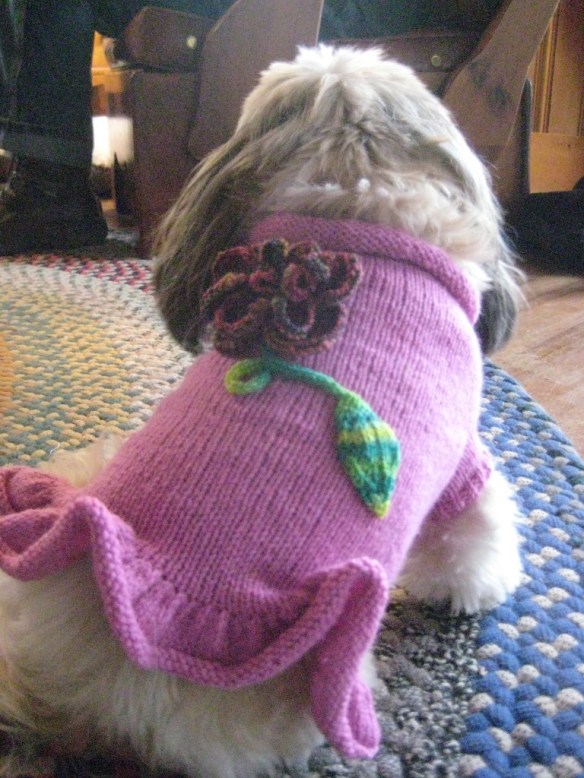
Senorita Lolita (Copyright 2011 Prima Dogma by Queen Bee Knits

Senorita Lolita (Copyright 2011 Prima Dogma by Queen Bee Knits)
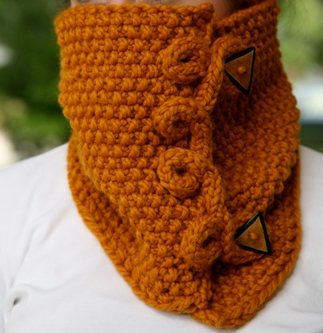
 

Butterscotch Cowl Copyright 2013 Queen Bee Knits Original

Butterscotch Cowl
Copyright 2013
Queen Bee Knits Original


I-cord is a spiral “tube” of knitting that is constructed by sliding the working piece from one side to the other side of your DPN.

It’s a great handle for knitted (and felted totes), it’s a great embellishment for knitted garments (and can be formed into flowers or stems or just about anything you can imagine!

It’s also very simple to knit!


Here is what you need to know to be successful when knitting i-cord!

Cast on the required number of stitches to be used for the i-cord (in this case, I used 6 stitches.)
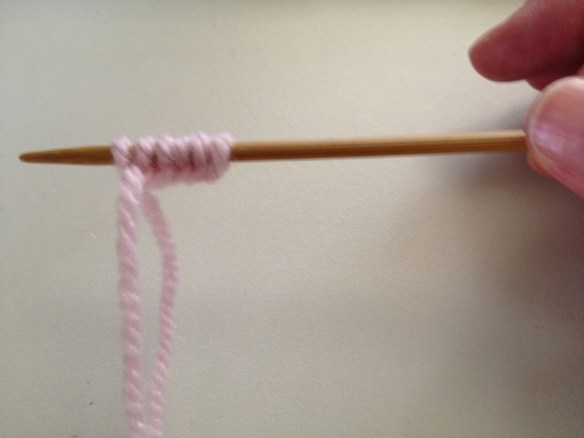
Cast on # of Stitches

Cast on # of Stitches

Slide your stitches to the right side of the DPN (do NOT turn your needle!)
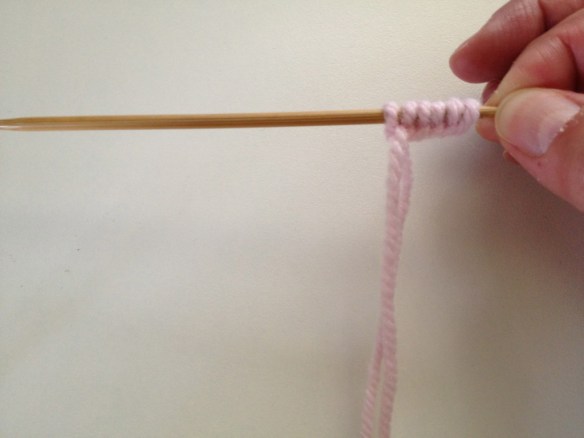
Slide stitches from cast on position at the left of the needle to the right side

Slide stitches from cast on position at the left of the needle to the right side

Knit all stitches (to knit the first stitch, you’ll bring the working yarn around the back of your needle and give the first stitch or two or three a good tug to pull the yarn so there won’t be a huge gap but don’t worry too much as the next few rounds will help even it out!)

Note that the stitches will be on the left side of the DPN. Do NOT turn your needle.

Knit all stitches

Knit all stitches (sorry, it’s a little blurry, but you get the idea!)

Slide the stitches to the right side of the needle and knit all stitches again.

Repeat sliding the stitches from the right to left of the DPN and knitting all stitches until i-cord is the right length for your project. It is also helpful to give the “tail” a tug or two to get the i-cord to stretch out & down.

After a few rows, you’ll start to see the tube starting to take form.
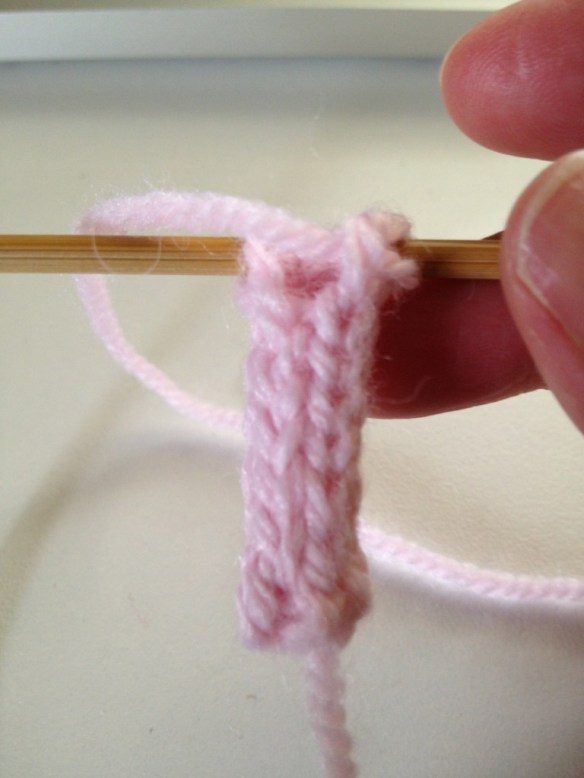
After a few rows of knitting (9 here)
After a few rows of knitting (9 here)


Queen Bee Knitting Tip

Queen Bee
Knitting Tip


Knitting Tip – When you’re knitting circularly (in the round) on double-pointed or circular needles, in order to keep your knitting from getting “ladders” where the needles meet, remember to give an extra tug (gently, don’t break your yarn!) on the first and second stitches as you start working on a new needle. This will lessen the chance of ladders happening which are unsightly in your knitted garments. Trust me, I’ve got plenty of experience! 🙂

So, there you go! Practice this a few times and you’ll have a great new trick in your knitting arsenal!

Gone knitting!
An Easter Story

When I got divorced, my life changed drastically. It was (I was?) all turned upside down and I didn’t realize that it would never be the same. I have been working for the last six (plus) years on building a new iteration of my life. Some parts are very, very different. Some are similar. I work to maintain threads of some traditions that we valued as a family even though the family is not the same. And there are some parts that I am grateful to have given up & thrown away. We’re making new traditions, too. Figuring out how to be a family after a divorce isn’t easy and it takes time and perseverance.

The part of my life that I love the most is my children and this “Easter” (at least the few days leading up to Sunday) I got to spend some time in New York City with all three of my children. There’s nothing like it. And I am so proud (I know I’m repeating myself) of the people they are becoming … productive, self-supporting, happy, and fun to be with. All following their passions and building lives of their own. What a mother wants for her children and yet, also, requiring her to let them go … a mother’s worst heartbreak. A double-edged sword.

But this post isn’t written to make you sad. It’s joyful. I’m so happy to have spent time together in New York. And my little dogs were happy to see their “kids”, too! We also got to meet my son-in-law-to-be’s family for the first time which was a treat. Despite her concerns that someone would start a conversation about religion or politics and that everything would explode, we all got along. We all love this young couple bunches. Enough to be there for them and support them, no matter what.

What I realized this Easter is that I am “rising up” into a new life where I will be happy; filling my life with people I love and following my passions, too. Leaving the world, I hope, a better place. Making a difference in the life of a child. Just as I taught my children to do, I am now encouraging the same bravery in myself.

I didn’t take enough pictures but I have a heart-full of  memories to carry with me. Until the next time we meet!

Gone Knitting.

Writing Your own Pattern – A Scarf

This Princess Scarf article (that I cannot read) has a photograph of a lovely scarf on the Princess of Norway’s neck. It’s a variegated pink yarn that is quite lovely with the background being her black and white outfit. (I tried, I really did, to get the photo inserted here. No luck! That’s why you have to click and go to see the scarf. It’s worth it, I promise, it’s very pretty!)

So, the big question here is, how do you knit a scarf like this?

IMG_0310The first challenge, obviously, is to find a similar yarn. I’d suggest printing the picture and heading out to your local yarn shop. It doesn’t matter what “weight” of yarn you choose because I’m going to tell you how to write your own pattern. But what you do need to know is how to find yarn that will mimic the scarf so that you won’t have a scarf that looks NOTHING like the Princess’!

The “Princess” scarf has a short color change. The pink and pink or pink and cream colors are fairly consistent across the knitted cloth in short lengths and nearly looks like it is “tweedy” or “mottled”. So you’re going to look for yarn that has short color changes. This yarn looks like it’s a lighter weight than a “chunky” or “bulky” yarn and is likely worsted or sport or even sock weight. It’s also a smooth yarn rather than a “thick and thin” or “slubby” or “fun fur” or even of a fiber that has a “haze” like angora or mohair. If you like another color, this is the time to choose color wisely – make sure you love it!

I went online to Jimmy Bean’s Wool and found a couple of different yarns that might work: Madelinetosh Prairie Short Skeins Yarn in Fragrant or Universal Yarns Bamboo Pop Yarn in Pink Joy. The first is a fingering weight and the second is a DK weight. Neither color is exactly like the Princess’, but both would work. Obviously, one will be lighter than the other. Take into consideration how cold it gets where you live! (I live in Florida and it’s not very cold here. Ever!)

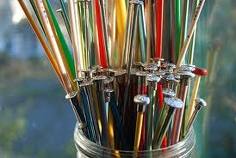
needlesOnce you’ve found your beautiful yarn, you need to match it with an appropriate sized needles. The Princess’ scarf is not lacy or open, the stitches are close together. The yarn band or tag will tell you the needle size recommended for your yarn. Sometimes there is a choice (it may say on a size 1-3 or 3-5). Next you need to mix up your yarn and needles by making a swatch. You can read my post about swatching here! And there is a great article on Knitty here. Now you’ll be able to see how your yarn is knitting up and see how many stitches you need to cast on!

Now, it’s time to decide how wide you want your scarf to be. I’m guessing that the Princess’ scarf is about eight inches wide. But you can make yours as wide or narrow as you like (and you can even start, frog and start again if you don’t like it. I give you permission!)

The Universal Pop yarn says to use needles size 5-7 and I’ll get 5-6 stitches per inch. Measuring my gauge, let’s say I get 5 stitches per inch on my US 5 needles. And I want my scarf to be 8 inches wide. I need to cast on 40 stitches. (5×8=40).

For this scarf, I’m going to use a stockinette stitch (knit on the right side, purl on the wrong side) and I’m going to continue in this pattern throughout. It looks like the original scarf is pretty long – and I’m going to knit my scarf until it’s about the same length (or the length I like) and then cast off on the right side.

Ta Da! You have just designed your very own scarf!

A couple of tips …

1. Your edge will be much prettier if you slip the first stitch in every row. Slip it purlwise or knitwise but be consistent!

2. Block your scarf! (See my post about blocking here!) It will hold its shape and the sides of stockinette stitch fabric are famous for rolling. Blocking will help it to unroll … but if you look at the Princess’ scarf, you’ll see it does roll a little bit! 🙂

Gone knitting!


“Can Do”

I have so enjoyed my teaching experience so far.

Today we had a short day – one class and then lunch with the Yarn Nook girls and off we went to sit at my brother & sister-in-law’s house on the back patio and knit! (Like we don’t get enough of it!) It felt good to have a short day after yesterday which was our marathon knitting and teaching day. We will probably not stay all day next week when I have three classes! Even crazy old me needs a break!

I love the challenge of teaching a student who is really stretching herself in a class. Challenging herself to do something that is really difficult and, perhaps, even something that she may not be ready to attempt yet. Those fearless knitters are the ones I admire. Partly because it’s so gutsy. Partly because I was not that type of knitter. Or at least that’s not how I classify myself.

There is a lot to be said for trying something that’s really difficult. It’s good for our brains, it’s good for our souls. The sense of accomplishment is incredible when you finally “get it!” I am happy with the progress that all of my students have made. They’ve worked hard. They’ve (mostly) had that “can do” attitude and it’s such fun to be teaching such a great group of women!

Gone knitting!


The Anatomy of a Sock

Circle of Life Socks

Circle of Life Socks for baby – pattern by Cat Bordhi

As I was sitting here in my atelier last night, I started thinking about how much people know about socks. I’ve knitted quite a few socks; baby socks, short socks, bed socks, yoga socks, cabled socks, patterned socks … toe up socks, cuff down socks, socks on DPNs, socks on two circs, magic loop socks … you get the general idea. Right?

Turkish Bed Sock

Turkish Bed Sock by Queen Bee Knits – pattern by Churchmouse Yarns

Well, what are the parts of a sock? Do you know what they’re all called? If you’re a knitter like me, you may … or may not! So, let’s do a post about the anatomy of a sock.

Whenever I’m preparing to write a post on knitting, I go out to the internet to search the topic. I searched the internet “Anatomy of a Sock” and this is what I found. A wonderful article, entitled Sock 101, already written beautifully by Knitty – a great resource and some fun free patterns – so I don’t have to write it myself. I can merely comment and compliment the Knitty article. Because there’s no use recreating the wheel, right?

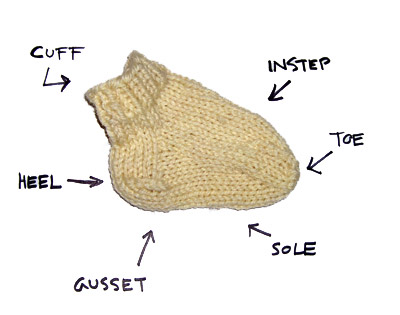
Knitty's Picture of the Anatomy of a Sock

Knitty’s Picture of the Anatomy of a Sock

There it is. The perfect picture of the anatomy of a sock! Perfect!

Depending on the pattern that you’re using, you may start at the toe or the cuff. Everyone stresses (at least when you’re a new sock knitter) about turning the heel. The beauty of it, however, is that all socks have all the same parts. Once you know the anatomy of ONE sock, you know it all! It’s beautiful, isn’t it?

Birthday Party Socks - by Queen Bee Knits

Birthday Party Socks – by Queen Bee Knits

If you haven’t knitted socks yet, you really should give it a shot – they’re so satisfying to knit and when they are finished and you put them on your feet or give them to someone as a gift, it’s amazing. They fit so well, they feel so good. And as a gift, they’re not soon forgotten – a true labor of love.

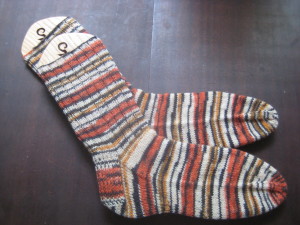
A personal sock story and then I’m going to end – I bought a ball of sock yarn with the idea that I’d make them for my son (then a freshman in college) because the colorway was similar to tiger stripes and he’s a Cincinnati Bengals fan – hey, no comments necessary, we lived his entire lifetime in Cincinnati! When I told him I was making him socks, he sweetly(-ish) told me he didn’t want hand-knit socks. Because I had the yarn, though, I didn’t pay attention and knitted the socks and gave them to him for Christmas one year.

Who Dey!

Who Dey! Socks by Queen Bee Knits

He graciously put them on his feet on Christmas day. Then, awhile later, I got a call from him,

“Mom, about the socks you knitted for me …?”

“Yes?”

“I love them. Will you make me some more?”

Like a good custom shirt or suit or whatever else is made specifically for you, hand made socks are super special. My brothers, boyfriend, niece and at least one daughter have pairs of their own. My goal is to knit some for all of my family. My son has three pairs that I’ve made to his request … including a brown pair that have a short cuff, a black pair and the Who Dey! socks that were his first. We all know that our first is something special!

The anatomy of a sock. There you have it. Now go get your yarn and needles and start knitting a pair! A good place to start is with Knitty’s Fuzzy Feet … worsted weight yarn and on a large scale. One step at a time. You can do it!

Gone knitting!

Happy New Year! Welcome 2013

It was a low key New Year’s Eve at our house last night. We welcomed in the New Year with a couple of friends, some food, drinks, games and lots of laughs.

2012 was a full year – a mixture of blessings and sorrow but without the sorrow, how can you appreciate the blessings. We said farewell to a beloved mother and an adored Cocker Spaniel. We welcomed a new great-nephew and a new niece. Celebrated birthdays and anniversaries. Entertained guests and family in Florida and Maine. Watched two children graduate from college and enter the “grown-up” world with new jobs. Joyously celebrated my big brother’s new liver and improving health. Enjoyed comfort and good health.

And now ahead to 2013! We entered the new year with a clean house, clean sheets, clean laundry and (most) projects finished. “Out with the old and in with the new!” I am looking forward to growing my business this year. To teaching more. To improving my website. To designing … or publishing some designs that I’ve created. To reaching a second level of certification.

Gone knitting!

Provisional Cast-On … Easy Method

Three Shades Mohair Cowl – Color Choices

Years ago, when I entered what we were allowed to call the Ravelympics, I had decided to  try to make my first lace scarf. I hit a road block when I read the patter for the first time and saw that there was a provisional cast on required. Since this was before the Internet really took off in my house, it was really difficult to find instructions that were clear and well-written (and illustrated) for this very visual knitter. Needless to say, I fell on my needles and was injured enough to totally back out of the challenge. (I also had kids at home and was working … not a lot of time to spend on doing something for myself back then!)

Fast forward a few years and I have learned how to do a couple of provisional cast ons. One with a crocheted chain that you then pick up stitches in the little bumps on the back (do not try this with black “waste” yarn) and another where you use an extra needle and let it hang at the bottom of your piece. Since I’m not an adept crocheter, my bumps are never consistent. The extra needle hanging at the bottom is a little bit cumbersome. So, I was looking for another option and this morning I found it!

Wendy Bernard over at Knit and Tonic has a great illustrative article on this long-tail provisional cast on where, in essence, you make a slip knot with your working yarn and your “waste” yarn (preferably something that is slippery) and then with your waste yarn over your thumb (toward you) and your working yarn over your index finger/pointer finger (away from you) you cast on just as you would normally. When you’ve gotten to your desired number of stitches (don’t count the slip knot/first stitch) cut your waste yarn and start your project.

The waste yarn is sitting nice and neatly down at the bottom of your work and can be easily unwound when you need to put your stitches back on your needles at the end of the project. Cool, yes?

I’ve just cast on 80 stitches in no time! Thanks, Wendy! I love it when you can learn something new and apply it to your day to cut off a few hours of tedious work!

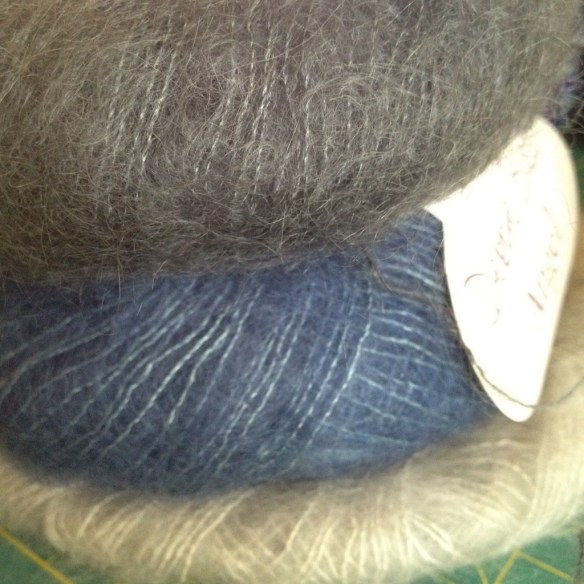
My new project is another mohair cowl. It’s knitted a bit on the bias which makes it a little bit more interesting. This one is a custom order from a client in New York. After I made the first one, I thought about making one in three shades and she liked the idea, too. So we’re using a silver, a charcoal and a denim color – I think it’s going to be lovely! Kind of like the ombre garments and home furnishings that you’re seeing everywhere! The yarn that I’m using is called DK weight (but I’d say it’s more a fingering weight) and it’s Rowan’s kidsilk haze in charcoal #639, Debbie Bliss Angel in denim #15008 and kid seta Madil in a silver (#408) colorway. I will start with the charcoal, then head into denim and last, add the silver. I’m pretty excited to see what it looks like – I’m sure we’ll all be delighted at the results!

So, there you go! Learn something new today!

Gone knitting!

Teaching Calendar

You may know (if you follow me on Facebook) that I’ve posted my teaching calendar for November and December.

I love teaching knitting. It allows me to share this craft that I am so passionate about and it gives me a setting where I can meet all kinds of new people.

I need to come up with some ideas about what FUN classes to teach after the basics are learned! I think I’ll run to the store today and “steal” a ball of the ruffled yarn and make a scarf for the open house on Saturday … and did I mention that all the classes purchased on Saturday are half price?!

Classes purchased on Saturday (at Michaels in Sanford between 11am and 3pm) at our Open House are half price! HALF PRICE!

To see my teaching schedule for September through December click HERE! And then come in on Saturday to sign up and pay for half price classes through 2013! I promise that we’ll have fun!

Gone knitting!

Destruction before Construction

The short story is this …

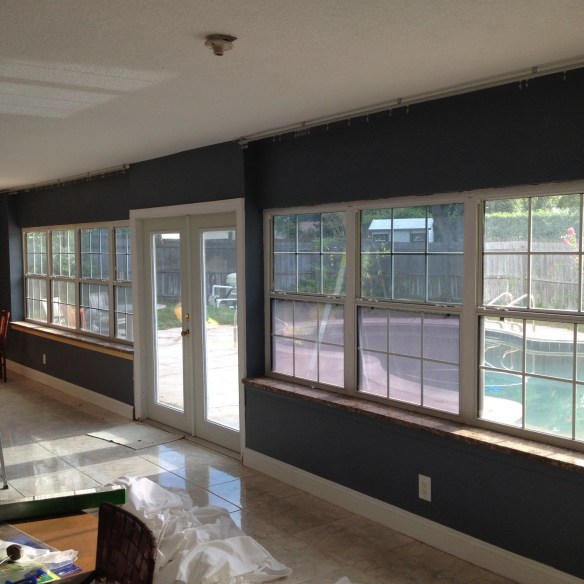
N. bought this house from a bank. Our inspector found a bunch of stuff wrong with it. The bank and N. came to an agreement over the price. The bank neglected to share that there was a known permitting problem with the county. A year or so after the closing, N. was “served” with notice, by the county, that he was being taken to court because of a lack of permitting on the “addition” … we were clueless!

Banks are unethical in every way. Not only do they loan money to poor suckers that they can’t afford but they also don’t have to (and don’t choose to) share potential problems that they know about because they don’t live in the house! Ugh.

So, now our back wall is being taken out (at our expense) and it’s hurricane season!

Before – just without curtains!

Off we go on another adventure!

Gone knitting!

Fun and Games – Random Stripe Generator

I found this wonderful knitting tool on a blog. (Does anyone else get lost following from one blog to another around the Internet?) Anyway, I digress …

I found this wonderful knitting tool on Caitlin’s blog (biscuitsandjam dot com) and it helps you create a random stripe pattern for your knits. If, for example you’re knitting a striped scarf, you can click on the colors of yarn you want to use and the number/numbers of rows in each stripe that you want to have in your scarf and the random generator shows you what your scarf will look like.

Better yet, if you don’t like the first pattern, refresh your screen and it will show you another and another and another until you love one. Scroll down and there’s your pattern! Marvelous!

Here’s the link to take you (magically) to biscuitsandjam dot com’s random stripe generator … have fun playing with stripes! And a big thank you to Caitlin (in Portland, OR) for the tool. And the fun blog!